PoE gear kept getting more power-hungry through 2026 — WiFi 6E and WiFi 7 access points, PTZ conference cameras, and VoIP phones all draw more than the old 15.4W standard, which is why TRENDnet rolled out a new NDAA/TAA-compliant injector lineup (the TPE-114GI and TPE-116GI) this year aimed squarely at buyers who need supply-chain compliance alongside more watts. If you’re adding one wired PoE device to a home office network and don’t want to replace your entire switch, an injector is still the fastest, cheapest way to do it.
A PoE injector takes a standard Ethernet connection and adds power to it, so you can run an access point, camera, or VoIP phone from a single cable with no separate power brick. Unlike a PoE switch, which powers every port, an injector adds power to exactly one connection — the right tool when you’re adding a single PoE device to a network built on a non-PoE router or switch.
Comparison
| Spec | TP-Link TL-PoE160S | TRENDnet TPE-115GI | TRENDnet TPE-114GI | TRENDnet TPE-113GI | TRENDnet TPE-116GI |
|---|---|---|---|---|---|
| Rating | 8.4/10 | 8.7/10 | 8.3/10 | 8.1/10 | 8.6/10 |
| Price | $18.57-$19.99as of Oct 18, 2026 | $21.60-$24.99as of Oct 18, 2026 | $19.99as of Oct 18, 2026 | $19.99as of Oct 18, 2026 | $39.99as of Oct 18, 2026 |
| Standard | 802.3af/at | 802.3af/at | 802.3af/at | 802.3af | 802.3af/at/bt |
| Max Power | 30W (PoE+) | 30W (PoE+) | 30W (PoE+) | 15.4W | 60W (PoE++) |
| Speed | Gigabit (2x RJ45 ports) | Gigabit full duplex | Gigabit | Gigabit full duplex | Gigabit |
| Housing | Plastic, integrated power supply | Metal, integrated power supply | — | — | Metal |
| Dimensions | 4.9 x 2.3 x 1.4 in | — | 4.3 x 2.2 x 1.3 in | 2.6 x 2.0 x 1.0 in | 6.1 x 2.3 x 1.3 in |
| Warranty | 2 Year | 3 Year | 3 Year | 3 Year | 3 Year |
| Compliance | — | — | NDAA & TAA Compliant | — | NDAA & TAA Compliant |
| Protection | — | — | — | Short circuit protection | — |
| Check Price → | Check Price → | Check Price → | Check Price → | Check Price → |
Prices change daily — tap Check Price for the current Amazon price.
The Picks
TP-Link TL-PoE160S
Pros
- Cheapest way to add a single PoE+ port without buying a managed switch
- Auto-senses whether the connected device needs 15.4W or 30W
- Plug-and-play — no configuration, no app, no login
- Compact enough to tuck behind a monitor or router without cable clutter
Cons
- Plastic housing runs noticeably warmer than metal-bodied competitors under sustained 30W load
- Only a 2-year warranty versus 3 years on most TRENDnet alternatives
- No surge protection beyond basic overcurrent cutoff
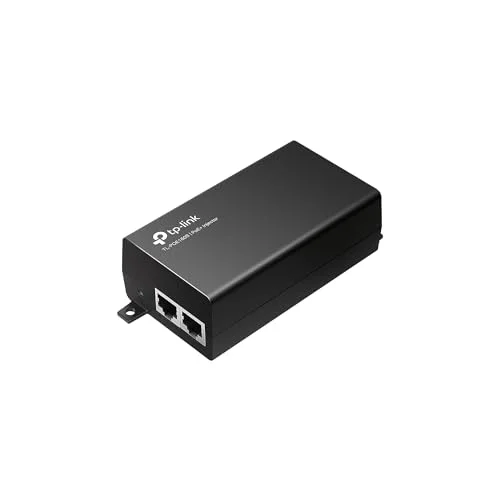
The TL-PoE160S is the injector to buy if you just need to add power to one PoE+ device and don’t want to think about it further. It auto-senses whether the connected gear needs 15.4W or 30W and adjusts automatically, so there’s no manual switch or configuration step. At under $20, it undercuts most of the competition while still hitting the full PoE+ spec.
The plastic housing is the trade-off. It works fine for a camera or access point that’s intermittently active, but running it at a sustained 30W — powering something like a PTZ camera around the clock — it runs warmer than the metal-bodied alternatives. For light, occasional PoE use on a budget, it’s still the easiest recommendation here.
TRENDnet TPE-115GI
Pros
- Metal housing dissipates heat far better than plastic injectors at full 30W load
- Highest sales volume of any injector in this roundup, with a long track record
- Auto-sensing logic correctly matches power to PoE or PoE+ devices automatically
- 3-year warranty beats most budget alternatives
Cons
- Some buyers report a unit failing within the first year, so keep the receipt
- A few owners noted the output reads 54V rather than a strict 48V, which can matter for picky PoE devices
- No gigabit passthrough speed boost — standard gigabit only, same as cheaper options
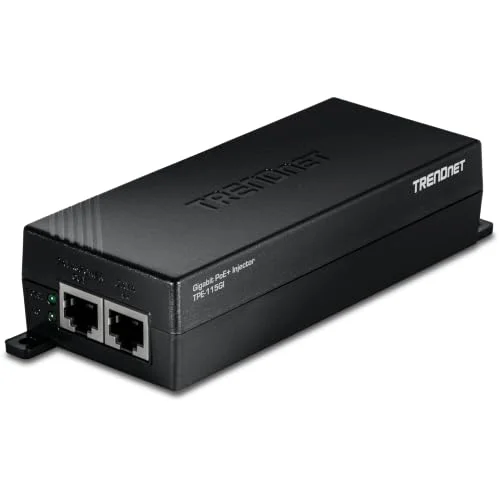
The TPE-115GI is the injector most networking pros reach for by default, and the sales numbers back that up — it’s been the highest-volume gigabit PoE+ injector on Amazon for years. The metal housing handles heat better than plastic competitors, the auto-sensing logic correctly identifies PoE vs. PoE+ devices, and the 3-year warranty is twice what the cheapest options offer.
It’s not flawless — a handful of buyers report a unit failing within the first year, and the output reads closer to 54V than a strict 48V, which can matter if you’re powering something finicky. For most home office setups adding a camera, access point, or VoIP phone, it’s still the safest default pick.
TRENDnet TPE-114GI
Pros
- NDAA and TAA compliance matters if you do contract work for government agencies or regulated clients
- Smaller and lighter than the TPE-115GI at the same price and power rating
- 3-year warranty and the same auto-sensing PoE/PoE+ logic as TRENDnet's established line
- Newest injector in TRENDnet's lineup, released as part of its 2026 compliance-focused refresh
Cons
- No real performance advantage over the older TPE-115GI if compliance isn't a requirement
- Still capped at 30W — can't power higher-draw PTZ cameras or WiFi 6E/7 access points
- Newer model means less long-term failure-rate data than the TPE-115GI
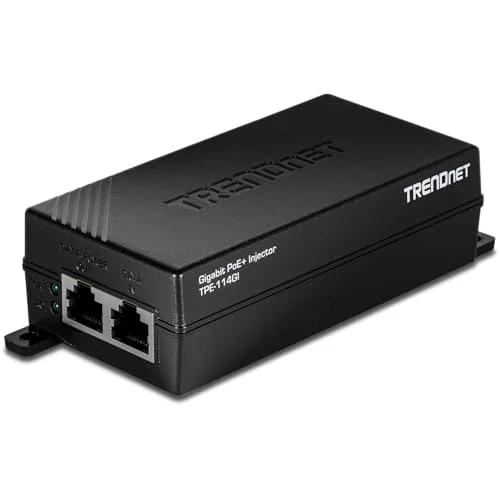
The TPE-114GI is functionally the same injector as the TPE-115GI — same 30W PoE+ ceiling, same auto-sensing, same 3-year warranty — but it’s NDAA and TAA compliant, which matters if you do contract work for a government agency or a client with supply-chain restrictions on networking hardware. It’s also noticeably smaller and lighter than the 115GI at the same price.
If compliance isn’t a factor for your work, there’s no reason to pick this over the more established TPE-115GI — you’re paying the same price for a newer unit with less of a track record. But for remote contractors who need to document compliant hardware, this is the easy default in the 30W tier.
TRENDnet TPE-113GI
Pros
- Cheapest gigabit injector in this roundup at under $18
- Tiny footprint — barely bigger than the Ethernet plug itself
- 3-year warranty matches the pricier TRENDnet models
- Plenty of power for basic IP cameras, VoIP phones, and simple access points
Cons
- Capped at 15.4W standard PoE — can't power anything requiring PoE+ or PoE++
- No PoE+ auto-step-up, so it's a dead end if you upgrade to higher-draw gear later
- Amazon stock on this listing runs scarce — order it as soon as you decide you need it
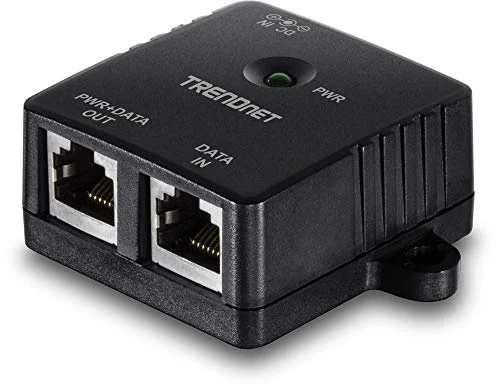
The TPE-113GI is the injector to buy when you just need standard 15.4W PoE and nothing more — a basic IP camera, a simple VoIP phone, or an older access point that doesn’t need PoE+. It’s the cheapest gigabit-rated injector in this roundup and small enough to disappear behind a router or desk leg.
The trade-off is the power ceiling. There’s no PoE+ auto-step-up here — if you upgrade to a higher-draw device later, this injector won’t power it and you’ll need to buy again. For a known 15.4W device, though, there’s no reason to spend more.
TRENDnet TPE-116GI
Pros
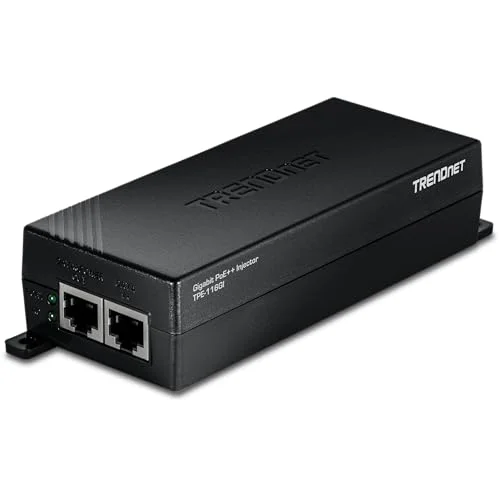
- 60W of PoE++ power handles WiFi 6E/7 access points and PTZ cameras that 30W injectors can't run
- NDAA/TAA compliant, same as the TPE-114GI, for contract and compliance-sensitive buyers
- Metal housing and 3-year warranty hold up to the higher sustained power draw
- Backward compatible — auto-steps down to 15.4W or 30W for lower-draw devices
Cons
- Nearly double the price of the standard 30W injectors in this roundup
- Overkill for a single access point or basic IP camera that only needs 15.4W
- Larger footprint than the compact 30W models — needs more desk or wall space
The TPE-116GI is the injector to buy when 30W isn’t enough. WiFi 6E and WiFi 7 access points routinely draw more than standard PoE+ can supply, and PTZ conference cameras with built-in heating or pan-tilt motors can exceed it too. At 60W of PoE++, this injector covers both, auto-stepping down to 30W or 15.4W for lighter devices so one injector works across your whole PoE lineup.
The price nearly doubles the standard 30W injectors, and the metal housing is noticeably larger — plan for more desk or wall space. But if you’ve bought a high-draw access point or camera and discovered your existing injector can’t power it, this is the fix, and the NDAA/TAA compliance is a bonus for anyone who needs documented supply-chain compliance.
PoE Injector Buying Guide
Do You Need an Injector or a Switch?
If you’re adding exactly one PoE device — a single access point, camera, or VoIP phone — to a network built on a non-PoE router, an injector is cheaper and simpler than replacing your switch. If you’re adding three or more PoE devices, a PoE switch is the better investment; running multiple injectors gets messy fast.
802.3af vs 802.3at vs 802.3bt (PoE++)
- 802.3af (PoE): Up to 15.4W. Fine for basic IP cameras and simple access points.
- 802.3at (PoE+): Up to 30W. Covers most modern access points, PTZ cameras, and VoIP phones. This is the sweet spot for most home offices.
- 802.3bt (PoE++): Up to 60W or more. Needed for WiFi 6E/7 access points, cameras with heaters or motorized pan-tilt, and other high-draw gear.
Check your device’s power requirement before buying — an injector that can’t supply enough wattage simply won’t power the device, even if the Ethernet connection works.
NDAA and TAA Compliance
If you do contract or government-adjacent work, NDAA (National Defense Authorization Act) and TAA (Trade Agreements Act) compliance restricts networking hardware from certain manufacturers. TRENDnet’s 2026 lineup — the TPE-114GI and TPE-116GI — was built specifically to meet this requirement without sacrificing the plug-and-play simplicity of a standard injector. If compliance doesn’t apply to your work, it’s not worth paying extra for.
Metal vs Plastic Housing
Metal-bodied injectors dissipate heat more effectively under sustained load, which matters if the connected device draws near the injector’s max rating around the clock. For intermittent use — a camera that’s mostly idle, an access point with light traffic — plastic housings are fine and usually cheaper.
Matching Voltage to Your Device
Most PoE devices are flexible about exact voltage within spec, but a few — especially older or budget cameras — are picky about receiving exactly 48V rather than the 52-54V some injectors output. If a device behaves oddly after an injector swap, check its documentation for a strict voltage requirement before assuming the injector is defective.
A solid wired network is also easier to manage with good cable management — a single PoE injector and cable is a lot less clutter than a wall wart for every device.
FAQ
Q: Can a PoE injector power a device that doesn’t support PoE? A: No. The device on the other end needs a PoE-compatible port (built-in or via a splitter) to accept power over the Ethernet cable. Plugging a PoE injector into a standard non-PoE device’s Ethernet port will not damage it, but it also won’t power it.
Q: Will a PoE injector slow down my network speed? A: No, as long as you buy a gigabit-rated injector. Every injector in this roundup passes through full gigabit speed — the injector only adds power, it doesn’t throttle data.
Q: How far can I run a cable from a PoE injector? A: Up to 100 meters (328 feet), the same distance limit as any standard Ethernet run. PoE doesn’t reduce your effective cable distance.
Q: Can I use a PoE injector with a non-PoE switch? A: Yes. Plug the injector between your non-PoE switch (or router) and the PoE device. The injector adds power to that single connection without affecting any other port on the switch.
Q: What happens if I use an injector with less power than my device needs? A: Most PoE devices simply won’t power on, or will power on in a reduced-capability mode (for example, an access point running without its full radio power). Check your device’s wattage requirement and buy an injector rated at or above it.
The Bottom Line
For most home offices adding a single camera, access point, or VoIP phone, the TRENDnet TPE-115GI is the safest pick — metal housing, strong track record, and a 3-year warranty for about $22-25. If you’re on a tighter budget, the TP-Link TL-PoE160S does the same job for under $20.
Only need standard 15.4W PoE for a basic camera or phone? The TRENDnet TPE-113GI is the cheapest way to get there. Need NDAA/TAA compliance for contract work, the TRENDnet TPE-114GI matches the 115GI’s specs with documented compliance. And if your access point or camera needs more than 30W, the TRENDnet TPE-116GI is the one injector here built to handle it.
An injector is a $20-40 fix for a problem that would otherwise mean buying an entirely new PoE switch. Match the wattage to your device, and it’s a five-minute install.
Detailed Reviews
TP-Link TL-PoE160S
Pros
- Cheapest way to add a single PoE+ port without buying a managed switch
- Auto-senses whether the connected device needs 15.4W or 30W
- Plug-and-play — no configuration, no app, no login
- Compact enough to tuck behind a monitor or router without cable clutter
Cons
- Plastic housing runs noticeably warmer than metal-bodied competitors under sustained 30W load
- Only a 2-year warranty versus 3 years on most TRENDnet alternatives
- No surge protection beyond basic overcurrent cutoff
TRENDnet TPE-115GI
Pros
- Metal housing dissipates heat far better than plastic injectors at full 30W load
- Highest sales volume of any injector in this roundup, with a long track record
- Auto-sensing logic correctly matches power to PoE or PoE+ devices automatically
- 3-year warranty beats most budget alternatives
Cons
- Some buyers report a unit failing within the first year, so keep the receipt
- A few owners noted the output reads 54V rather than a strict 48V, which can matter for picky PoE devices
- No gigabit passthrough speed boost — standard gigabit only, same as cheaper options
TRENDnet TPE-114GI
Pros
- NDAA and TAA compliance matters if you do contract work for government agencies or regulated clients
- Smaller and lighter than the TPE-115GI at the same price and power rating
- 3-year warranty and the same auto-sensing PoE/PoE+ logic as TRENDnet's established line
- Newest injector in TRENDnet's lineup, released as part of its 2026 compliance-focused refresh
Cons
- No real performance advantage over the older TPE-115GI if compliance isn't a requirement
- Still capped at 30W — can't power higher-draw PTZ cameras or WiFi 6E/7 access points
- Newer model means less long-term failure-rate data than the TPE-115GI
TRENDnet TPE-113GI
Pros
- Cheapest gigabit injector in this roundup at under $18
- Tiny footprint — barely bigger than the Ethernet plug itself
- 3-year warranty matches the pricier TRENDnet models
- Plenty of power for basic IP cameras, VoIP phones, and simple access points
Cons
- Capped at 15.4W standard PoE — can't power anything requiring PoE+ or PoE++
- No PoE+ auto-step-up, so it's a dead end if you upgrade to higher-draw gear later
- Amazon stock on this listing runs scarce — order it as soon as you decide you need it
TRENDnet TPE-116GI
Pros
- 60W of PoE++ power handles WiFi 6E/7 access points and PTZ cameras that 30W injectors can't run
- NDAA/TAA compliant, same as the TPE-114GI, for contract and compliance-sensitive buyers
- Metal housing and 3-year warranty hold up to the higher sustained power draw
- Backward compatible — auto-steps down to 15.4W or 30W for lower-draw devices
Cons
- Nearly double the price of the standard 30W injectors in this roundup
- Overkill for a single access point or basic IP camera that only needs 15.4W
- Larger footprint than the compact 30W models — needs more desk or wall space