The SD Association’s own 2026 memory technology outlook points at a format shift already underway: SD Express is showing up on new laptops from Acer, ASUS, Dell, HP, Lenovo, and MSI, and Nintendo built the Switch 2 around microSD Express as its only expansion storage option. None of that has reached mainstream mirrorless and cinema cameras yet, though — most content creators are still shooting on UHS-II SD cards or CFexpress Type B, and that’s the gap this roundup fills. The bigger practical shift for buyers right now isn’t a new card format, it’s spec fragmentation: reader prices span from under $10 for a basic USB 3.0 dual-slot adapter to well over $80 for a CFexpress-plus-SD reader, and picking the wrong one either bottlenecks a fast card or pays for speed you’ll never use.
A card reader only matters as much as the card and camera behind it — a $10 UHS-I reader can’t get more than about 100MB/s out of even the fastest UHS-II card, and a CFexpress reader is wasted money if your camera only ever shoots SD. Match the reader to your actual gear before chasing the fastest number on the box.
Quick pick: Hybrid shooters running a CFexpress camera alongside an SD-based second camera should get the ProGrade Digital PG05.5. If your kit mixes CFexpress, CFast, and microSD formats across multiple cameras, the SABRENT CR-C4PM covers all four in one reader. SD-only shooters who just want the fastest UHS-II speed should skip straight to the SABRENT CR-CSDM for the best price-to-speed ratio.
Quick Picks
| Spec | ProGrade Digital CFexpress Type B & SDXC Card Reader (PG05.5) | SABRENT USB-C Multi-Card Reader (CR-C4PM) | SanDisk Extreme PRO SD UHS-II USB-C Reader (SDDR-409) | SABRENT USB-C Dual-Slot UHS-II SD & microSD Reader (CR-CSDM) | UGREEN SD Card Reader, USB 3.0 Dual-Slot |
|---|---|---|---|---|---|
| Rating | 9.2/10 | 8.8/10 | 8.5/10 | 8.4/10 | 7.6/10 |
| Price | Unavailable | $79.99as of Oct 11, 2026 | $60.93as of Oct 11, 2026 | $19.99as of Oct 11, 2026 | $8.99-$9.99as of Oct 11, 2026 |
| Slots | 1x CFexpress Type B, 1x SDXC UHS-II | CFexpress Type B, CFast 2.0, SD, microSD (4 total) | 1x SD UHS-II (SDHC/SDXC) | 1x SD UHS-II, 1x microSD UHS-II (simultaneous) | 1x SD, 1x microSD (reads both simultaneously) |
| Interface | USB 3.2 Gen 2 (10Gbps) | USB-C, up to 10Gbps | Reversible USB Type-C | USB-C, USB 3.2 Gen 1 (5Gbps) | USB 3.0 (5Gbps) |
| Rated Speed | Up to 1,250MB/s combined | CFexpress up to 950MB/s, CFast 2.0 up to 460MB/s, SD/microSD UHS-II up to 312MB/s | Up to 500MB/s | Up to 312MB/s per slot | Up to 104MB/s (UHS-I) |
| Cables Included | USB-C to USB-C and USB-C to USB-A (18-inch) | — | — | — | — |
| Mounting | Adhesive magnetic plate for laptop mounting | — | — | — | — |
| Warranty | 2-year limited | — | — | — | — |
| Build | — | Aluminum body with ABS casing | — | Aluminum housing with LED activity indicator | Aluminum alloy shell |
| Power | — | Bus-powered, no external adapter | — | — | — |
| OS Support | — | Windows, macOS, Linux | — | Windows 8+, macOS 12+ | — |
| Real-World UHS-II Speed | — | — | Roughly 270-300MB/s sequential in independent benchmarks | — | — |
| Backward Compatibility | — | — | UHS-I and non-UHS SD cards | — | — |
| Max Card Capacity | — | — | — | — | Up to 2TB per slot |
| Check Price → | Check Price → | Check Price → | Check Price → | Check Price → |
Prices change daily — tap Check Price for the current Amazon price.
1. ProGrade Digital CFexpress Type B & SDXC Card Reader (PG05.5) — Editor’s Pick
ProGrade Digital CFexpress Type B & SDXC Card Reader (PG05.5)
Pros
- One reader covers both halves of a hybrid mirrorless kit — a full-size CFexpress Type B slot for RAW video and a UHS-II SD slot for stills or B-roll cards, no second device needed
- USB 3.2 Gen 2's 10Gbps bus is fast enough that the reader isn't the bottleneck on either slot, even offloading a full CFexpress card of 4K footage
- Included magnetic mounting plate sticks to a laptop lid, turning the reader into a semi-permanent part of a mobile editing setup instead of a loose dongle
- Owner feedback describes the build as noticeably solid for a bus-powered reader, with several longtime ProGrade users citing it as their go-to for post-production workflows
Cons
- Most expensive reader in this roundup — the CFexpress slot is dead weight if your camera only shoots SD cards
- A handful of owner reports describe units failing after a few years of light use, worth registering the warranty on arrival
- No CFast or microSD support, so cinema cameras still using CFast 2.0 need a different reader entirely
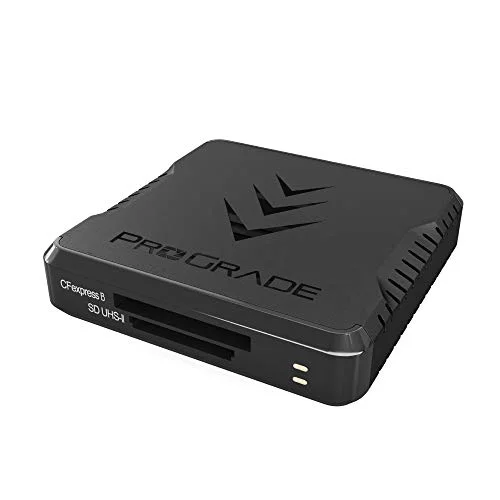
Most current mirrorless bodies from Canon, Nikon, and Sony shoot to a mix of CFexpress Type B and SD cards in the same camera, and the PG05.5 is built around exactly that pairing — one CFexpress Type B slot and one UHS-II SD slot, both running over a single USB 3.2 Gen 2 connection rated up to 1,250MB/s combined. That’s enough headroom that neither slot bottlenecks the other when you’re pulling a full CFexpress card of 4K or 8K footage off at the same time as a stills-only SD card.
The included magnetic mounting plate is a small detail that matters more than it sounds for anyone editing on the road — it sticks to a laptop lid and turns the reader into a fixed part of a mobile workstation instead of a dongle that slides around a desk. ProGrade built its reputation on professional card readers specifically for filmmakers and photographers, and owner feedback backs that up, with longtime users citing it as their default choice for post-production offload.
The tradeoffs are cost and a hard format lock: this is the most expensive reader here, and the CFexpress slot is simply unused if your camera never shoots that format. A small number of owner reports also describe units failing after a few years of light use, so registering the warranty on arrival is worth the two minutes it takes. For a hybrid CFexpress-and-SD shooter, though, nothing else in this roundup replaces two readers with one as cleanly.
2. SABRENT USB-C Multi-Card Reader (CR-C4PM) — Best for Multi-Format Shooters
SABRENT USB-C Multi-Card Reader (CR-C4PM)
Pros
- Covers four card formats in one device — useful if your gear bag mixes a mirrorless CFexpress camera with an older CFast-based cinema camera and a drone that still uses microSD
- Aluminum body with an ABS outer shell is built for heat dissipation during long transfer sessions, not just cosmetics
- Integrated 6-inch USB-C cable means one less cable to lose in a camera bag
- Plug-and-play across Windows, macOS, and Linux with no driver install
Cons
- CFast 2.0 support is dead weight for most buyers today — it mainly matters for older Canon Cinema EOS and Blackmagic cameras, not current mirrorless bodies
- Four card slots in one small aluminum body make it bulkier than a single-format reader, less pocketable for a minimalist kit
- Costs nearly as much as the CFexpress + SD reader above while running SD cards at the same UHS-II ceiling
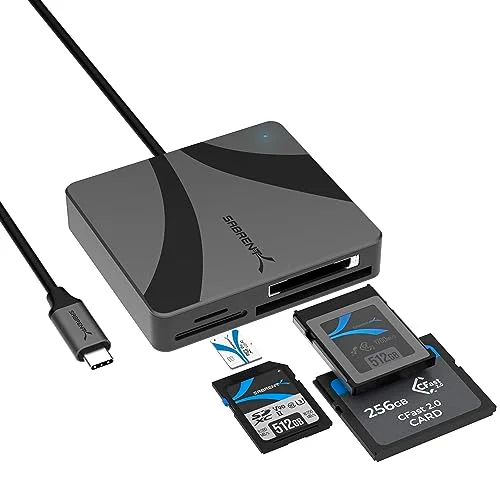
The CR-C4PM goes a step further than the ProGrade reader by adding a CFast 2.0 slot alongside CFexpress Type B, SD, and microSD — four card formats in one aluminum-and-ABS body. That combination targets a specific but real situation: a content creator whose gear bag spans a newer CFexpress mirrorless camera, an older CFast-based cinema camera, and a drone or action cam still shooting microSD.
Sabrent rates the CFexpress slot up to 950MB/s and the CFast 2.0 slot up to 460MB/s, both over a 10Gbps USB-C connection with an integrated 6-inch cable, so there’s no separate cable to dig out of a bag. The aluminum body with an ABS outer shell is designed for heat dissipation during long transfer sessions rather than just looking rugged, and it runs driver-free on Windows, macOS, and Linux.
The catch is that CFast 2.0 support is genuinely niche today — it mainly matters for older Canon Cinema EOS and Blackmagic cameras, not current mirrorless bodies — so a lot of buyers are paying for a slot they’ll never plug a card into. Cramming four slot types into one reader also makes it bulkier than a single-format device, and at $79.99 it costs nearly as much as the ProGrade reader while capping SD/microSD transfers at the same UHS-II ceiling. For anyone actually straddling CFexpress and CFast gear, it’s the only reader here that covers both.
3. SanDisk Extreme PRO SD UHS-II USB-C Reader (SDDR-409) — Best for SD-Only Shooters
SanDisk Extreme PRO SD UHS-II USB-C Reader (SDDR-409)
Pros
- Independent benchmark testing found it delivering the fastest real-world transfer speeds of the SD-only adapters compared, useful for offloading large RAW photo batches or 4K video fast
- Reversible USB-C connector plugs in either way, a small but real convenience during a fast card-swap between shots
- Backward compatible down to UHS-I and non-UHS cards, so an older SD card from a secondary camera still works at its native speed
- SanDisk's name recognition and long track record in card readers make it an easy pick for shooters who already run SanDisk cards
Cons
- Single SD slot only — no microSD, no CFexpress, so a hybrid shooter with a drone or action cam needs a second reader
- Occasionally shows an extended shipping window on Amazon rather than same-day dispatch — worth checking current stock before ordering if you need it fast
- Costs more than readers offering the same UHS-II ceiling with a second card slot included
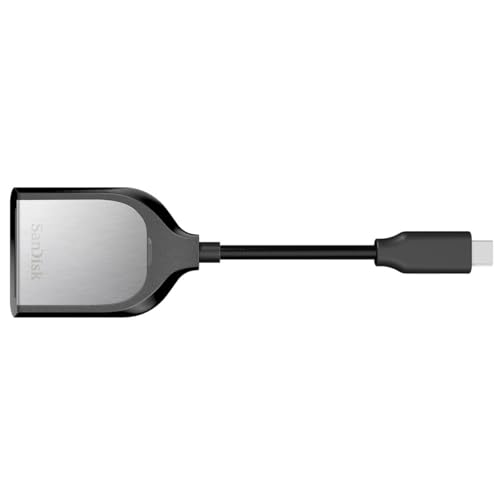
If your camera only ever shoots SD cards, paying for a CFexpress slot you’ll never use doesn’t make sense — the SanDisk Extreme PRO reader skips that entirely and focuses on getting the most out of a single UHS-II SD slot. Independent benchmark testing found it posting the fastest real-world transfer speeds among the SD-only adapters tested, in the neighborhood of 270-300MB/s sequential on a fast UHS-II card, well ahead of its rated 500MB/s ceiling in practice but still the quickest of its class.
The reversible USB-C connector is a small convenience that adds up over a shoot day full of card swaps, and backward compatibility down to UHS-I and non-UHS cards means an older SD card from a secondary camera or backup body still reads at its native speed rather than getting rejected. SanDisk’s long track record in card readers makes this an easy default for anyone already shooting on SanDisk media.
The obvious limitation is the single SD slot — there’s no microSD or CFexpress option, so a hybrid shooter with a drone or GoPro needs a second reader regardless. It’s also worth checking current Amazon stock before counting on it arriving same-day, since the listing has occasionally shown an extended shipping window rather than immediate dispatch. For a dedicated SD-only workflow, it’s still the fastest single-slot option in this roundup.
4. SABRENT USB-C Dual-Slot UHS-II SD & microSD Reader (CR-CSDM) — Best Value
SABRENT USB-C Dual-Slot UHS-II SD & microSD Reader (CR-CSDM)
Pros
- Full UHS-II speed on both an SD slot and a microSD slot for a fraction of the price of the CFexpress readers above
- Simultaneous transfer from both slots at once means a camera SD card and a drone or GoPro microSD card can offload in parallel
- Integrated 6-inch USB-C cable and aluminum housing keep it compact enough for a camera bag pocket
- 5Gbps USB 3.2 Gen 1 bus is still fast enough to hit the SD card's own UHS-II ceiling — the reader isn't the bottleneck for stills or 1080p/4K footage
Cons
- No CFexpress or CFast support at all, so it's out for anyone shooting on a current mirrorless flagship body
- 5Gbps interface caps combined dual-slot throughput lower than the 10Gbps CFexpress readers when both slots are maxed out at once
- Listing has shown intermittent low-stock status on Amazon — worth confirming availability before counting on next-day delivery
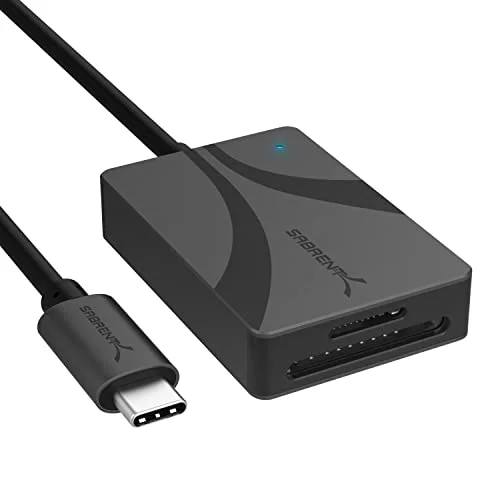
At $19.99, the CR-CSDM delivers the same 312MB/s UHS-II ceiling as readers costing four times as much, just without CFexpress or CFast support. It packs a full-size SD UHS-II slot and a microSD UHS-II slot into one aluminum housing, and both slots transfer simultaneously — useful for offloading a main camera’s SD card and a drone or GoPro’s microSD card in the same pass instead of swapping cards one at a time.
The integrated 6-inch USB-C cable and compact aluminum body make it an easy permanent resident in a camera bag pocket, and the 5Gbps USB 3.2 Gen 1 interface, while slower than the 10Gbps readers above, is still fast enough that it isn’t the bottleneck against a UHS-II SD card’s own speed ceiling for stills or 4K footage.
The tradeoffs are the ones you’d expect at this price: no CFexpress or CFast slot at all, so it’s not an option for anyone shooting a current mirrorless flagship, and running both slots at full UHS-II speed simultaneously will bump against the 5Gbps bus ceiling faster than it would on a 10Gbps reader. The listing has also shown intermittent low-stock status, so it’s worth confirming availability before assuming next-day delivery. For SD-and-microSD-only shooters who don’t need CFexpress, it’s the best speed-per-dollar reader here.
5. UGREEN SD Card Reader, USB 3.0 Dual-Slot — Best Budget
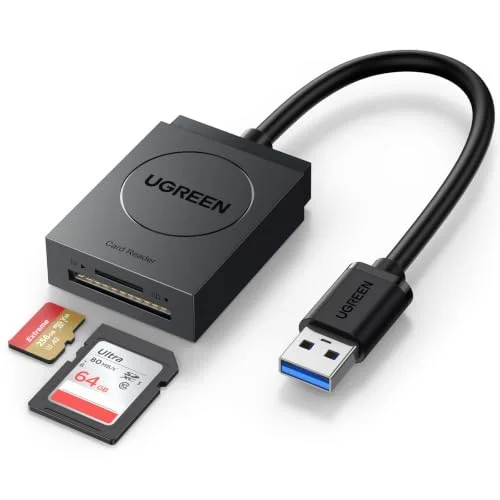
UGREEN SD Card Reader, USB 3.0 Dual-Slot
Pros
- Cheapest reader in this roundup by a wide margin, an easy add-on rather than a real purchase decision
- Reads an SD card and a microSD card at the same time, handy for offloading a camera card and a phone or drone card in one pass
- Compact aluminum shell with USB 3.0 speed is a real step up from the USB 2.0 adapters bundled with older cameras
- Independent testing clocked it close to its rated speed on a 95MB/s-rated card, confirming it performs near spec rather than falling short
Cons
- USB 3.0 UHS-I only — no UHS-II support, so it caps out around 100MB/s regardless of how fast the card itself is rated
- No CFexpress or CFast support, ruling it out for anyone shooting on current mirrorless or cinema cameras
- Casual, low-cost build quality — fine as a backup reader, not something to rely on as your only card reader for paid work
Under $10, the UGREEN reader isn’t trying to compete on speed — it’s the cheapest way to get a real USB 3.0 card reader instead of relying on a camera’s slow USB cable transfer or an ancient USB 2.0 adapter. It reads a full-size SD card and a microSD card simultaneously, which covers a common pairing of a main camera card and a phone or drone microSD card in one pass, and independent testing clocked it close to its rated speed on a 95MB/s card, confirming it performs near spec rather than underdelivering.
The compact aluminum shell keeps it pocket-sized, and at this price it’s an easy secondary or backup reader to toss in a bag without worrying about losing something expensive.
The real limitation is UHS-I-only support capped around 104MB/s — a fast UHS-II SD card will transfer no faster through this reader than a much cheaper UHS-I card would, so anyone shooting high-bitrate 4K or fast burst RAW photography will feel the ceiling. There’s also no CFexpress or CFast support whatsoever. Treat it as a backup or casual-use reader rather than the only card reader backing paid client work.
Buying Guide: How to Pick an SD Card Reader
Match the Reader to Your Camera’s Actual Card Format First
The single biggest mistake in this category is buying based on price or brand name before checking what your camera actually shoots. A CFexpress reader is wasted money on an SD-only camera, and an SD-only reader is useless the day you upgrade to a CFexpress body. If you shoot on two cameras with different formats, a combo reader like the ProGrade PG05.5 or SABRENT CR-C4PM saves carrying two separate readers.
UHS-II vs. UHS-I Actually Matters
A UHS-I reader caps out around 104MB/s no matter how fast the card itself is rated — plugging a 300MB/s UHS-II card into a UHS-I-only reader like the UGREEN doesn’t get you UHS-II speeds. If you’ve paid for fast UHS-II cards, pair them with a UHS-II reader like the SABRENT CR-CSDM or SanDisk Extreme PRO to actually use that speed.
Simultaneous Dual-Slot Transfer Saves Real Time
Readers like the SABRENT CR-CSDM and the UGREEN reader transfer from both card slots at once rather than one after another. For a shoot with a main camera card and a secondary drone or action cam card, that can cut offload time roughly in half compared to a single-slot reader used twice.
CFexpress and CFast Are Camera-Specific, Not Universal
CFexpress Type B covers most current high-end mirrorless bodies from Canon, Nikon, and Sony. CFast 2.0 is largely a legacy format tied to older Canon Cinema EOS and Blackmagic cameras. Don’t pay for either slot unless a camera in your actual kit uses it.
USB Interface Speed Sets the Ceiling
A 10Gbps USB 3.2 Gen 2 or USB-C connection, like on the ProGrade and SABRENT CR-C4PM readers, is needed to get full CFexpress speeds. A 5Gbps USB 3.2 Gen 1 or USB 3.0 connection, like the SABRENT CR-CSDM and UGREEN readers use, is still plenty fast for a single UHS-II SD card, just slower once you’re running multiple fast slots at once.
FAQ
Does a faster card reader actually speed up my file transfers, or does the card matter more? Both matter, and whichever one is slower sets the ceiling. A UHS-II card plugged into a UHS-I-only reader transfers at UHS-I speeds, and a fast UHS-II reader can’t exceed what a UHS-I card supports either. Match reader and card speed class together for the fastest real-world transfers.
What’s the real difference between UHS-I and UHS-II readers? UHS-I readers cap out around 104MB/s. UHS-II readers, like the SABRENT CR-CSDM and SanDisk Extreme PRO here, support up to roughly 300MB/s in real-world use — meaningfully faster for offloading large 4K video files or big RAW photo batches.
Do I need a CFexpress reader if my camera also shoots SD cards? Only if your camera actually records to CFexpress. Many current mirrorless bodies use CFexpress for high-bitrate video and SD for stills or backup — in that case, a combo reader like the ProGrade PG05.5 covers both cards without needing two separate devices.
Is SD Express something content creators need to worry about yet? Not yet for most camera work. SD Express is showing up in new laptops and in the Nintendo Switch 2’s microSD Express slot, but mainstream mirrorless and cinema cameras haven’t adopted it as a recording format, so UHS-II and CFexpress remain the formats that matter for offloading camera cards today.
Can a budget USB 3.0 reader like the UGREEN keep up with 4K video footage? For casual 4K footage on a UHS-I card, yes, within its roughly 100MB/s ceiling. For high-bitrate 4K/8K footage recorded on a fast UHS-II card, that ceiling becomes a real bottleneck — a UHS-II reader is worth the extra cost once your footage or card speed exceeds what UHS-I can move.
Conclusion
For a hybrid shooter running CFexpress and SD cards in the same camera, the ProGrade Digital PG05.5 is the cleanest single-reader solution and the top pick in this roundup. Anyone juggling CFexpress, CFast, and microSD across multiple cameras should get the SABRENT CR-C4PM instead, since it’s the only reader here covering all four formats. SD-only shooters who don’t need CFexpress get the best value from the SABRENT CR-CSDM’s full UHS-II speed at a fraction of the CFexpress readers’ price, while the SanDisk Extreme PRO is worth the extra cost if you want the fastest single-slot SD reader available. For a backup reader or a first upgrade off a USB 2.0 adapter, the UGREEN reader gets the job done for under $10. Whichever you pick, confirm it actually matches the card format your camera records to before checking price or speed specs.
Detailed Reviews
ProGrade Digital CFexpress Type B & SDXC Card Reader (PG05.5)
Pros
- One reader covers both halves of a hybrid mirrorless kit — a full-size CFexpress Type B slot for RAW video and a UHS-II SD slot for stills or B-roll cards, no second device needed
- USB 3.2 Gen 2's 10Gbps bus is fast enough that the reader isn't the bottleneck on either slot, even offloading a full CFexpress card of 4K footage
- Included magnetic mounting plate sticks to a laptop lid, turning the reader into a semi-permanent part of a mobile editing setup instead of a loose dongle
- Owner feedback describes the build as noticeably solid for a bus-powered reader, with several longtime ProGrade users citing it as their go-to for post-production workflows
Cons
- Most expensive reader in this roundup — the CFexpress slot is dead weight if your camera only shoots SD cards
- A handful of owner reports describe units failing after a few years of light use, worth registering the warranty on arrival
- No CFast or microSD support, so cinema cameras still using CFast 2.0 need a different reader entirely
SABRENT USB-C Multi-Card Reader (CR-C4PM)
Pros
- Covers four card formats in one device — useful if your gear bag mixes a mirrorless CFexpress camera with an older CFast-based cinema camera and a drone that still uses microSD
- Aluminum body with an ABS outer shell is built for heat dissipation during long transfer sessions, not just cosmetics
- Integrated 6-inch USB-C cable means one less cable to lose in a camera bag
- Plug-and-play across Windows, macOS, and Linux with no driver install
Cons
- CFast 2.0 support is dead weight for most buyers today — it mainly matters for older Canon Cinema EOS and Blackmagic cameras, not current mirrorless bodies
- Four card slots in one small aluminum body make it bulkier than a single-format reader, less pocketable for a minimalist kit
- Costs nearly as much as the CFexpress + SD reader above while running SD cards at the same UHS-II ceiling
SanDisk Extreme PRO SD UHS-II USB-C Reader (SDDR-409)
Pros
- Independent benchmark testing found it delivering the fastest real-world transfer speeds of the SD-only adapters compared, useful for offloading large RAW photo batches or 4K video fast
- Reversible USB-C connector plugs in either way, a small but real convenience during a fast card-swap between shots
- Backward compatible down to UHS-I and non-UHS cards, so an older SD card from a secondary camera still works at its native speed
- SanDisk's name recognition and long track record in card readers make it an easy pick for shooters who already run SanDisk cards
Cons
- Single SD slot only — no microSD, no CFexpress, so a hybrid shooter with a drone or action cam needs a second reader
- Occasionally shows an extended shipping window on Amazon rather than same-day dispatch — worth checking current stock before ordering if you need it fast
- Costs more than readers offering the same UHS-II ceiling with a second card slot included
SABRENT USB-C Dual-Slot UHS-II SD & microSD Reader (CR-CSDM)
Pros
- Full UHS-II speed on both an SD slot and a microSD slot for a fraction of the price of the CFexpress readers above
- Simultaneous transfer from both slots at once means a camera SD card and a drone or GoPro microSD card can offload in parallel
- Integrated 6-inch USB-C cable and aluminum housing keep it compact enough for a camera bag pocket
- 5Gbps USB 3.2 Gen 1 bus is still fast enough to hit the SD card's own UHS-II ceiling — the reader isn't the bottleneck for stills or 1080p/4K footage
Cons
- No CFexpress or CFast support at all, so it's out for anyone shooting on a current mirrorless flagship body
- 5Gbps interface caps combined dual-slot throughput lower than the 10Gbps CFexpress readers when both slots are maxed out at once
- Listing has shown intermittent low-stock status on Amazon — worth confirming availability before counting on next-day delivery
UGREEN SD Card Reader, USB 3.0 Dual-Slot
Pros
- Cheapest reader in this roundup by a wide margin, an easy add-on rather than a real purchase decision
- Reads an SD card and a microSD card at the same time, handy for offloading a camera card and a phone or drone card in one pass
- Compact aluminum shell with USB 3.0 speed is a real step up from the USB 2.0 adapters bundled with older cameras
- Independent testing clocked it close to its rated speed on a 95MB/s-rated card, confirming it performs near spec rather than falling short
Cons
- USB 3.0 UHS-I only — no UHS-II support, so it caps out around 100MB/s regardless of how fast the card itself is rated
- No CFexpress or CFast support, ruling it out for anyone shooting on current mirrorless or cinema cameras
- Casual, low-cost build quality — fine as a backup reader, not something to rely on as your only card reader for paid work