| Spec | Shure MV7+ | Rode PodMic USB |
|---|---|---|
| Rating | 9.0/10 | 8.3/10 |
| Price | $269.77-$299.00as of Oct 18, 2026 | $164.99-$190.00as of Oct 18, 2026 |
| Type | Dynamic (XLR + USB-C) | Dynamic (XLR + USB-C) |
| Polar Pattern | Cardioid | Cardioid |
| Frequency Response | 50Hz–16kHz | 20Hz–20kHz |
| Bit Depth / Sample Rate | 32-bit float / 48kHz | 24-bit / 48kHz |
| Connectivity | USB-C + XLR | USB-C + XLR |
| Monitoring | Zero-latency headphone jack | Zero-latency headphone jack (3.5mm) |
| Controls | LED touch panel, Auto Level Mode | Onboard volume knob, APHEX DSP via Rode Central |
| Weight | 0.55 kg (1.21 lbs) | 0.94 kg (2.07 lbs) |
| Check Price → | Check Price → |
Prices change daily — tap Check Price for the current Amazon price.
Disclosure: SetupRanked earns a commission on purchases made through links on this page, at no extra cost to you.
USB microphone shopping in 2026 has shifted away from spec-sheet comparisons and toward a simpler question: how well does the mic handle your actual room? Shure’s CES 2026 launch of the MV88 USB-C underlined that shift, leaning on Auto Level Mode and real-time denoising rather than raw frequency numbers. The Shure MV7+ and Rode PodMic USB are both dynamic mics built around that same idea — reject the room, keep the voice — but they solve it in different ways. One leans on automation, the other on onboard DSP you configure yourself. Quick pick: the Shure MV7+ wins if you want hands-off consistency; the Rode PodMic USB wins if you want deeper tone control and don’t mind dialing in gain yourself.
Quick Comparison
| Shure MV7+ | Rode PodMic USB | |
|---|---|---|
| Type | Dynamic | Dynamic |
| Price | $269–$319 | $179–$209 |
| Frequency Response | 50Hz–16kHz | 20Hz–20kHz |
| Auto Gain | Auto Level Mode | Manual (via Rode Central DSP) |
| Connectivity | USB-C + XLR | USB-C + XLR |
| Weight | 1.21 lbs | 2.07 lbs |
| Best For | Hands-off call audio | Tone-shaping control |
Why Two Dynamic Mics, Not a Dynamic vs Condenser Fight
Both of these mics use dynamic capsules, which is the more relevant home-office decision than brand. Dynamic capsules need the sound source close and direct — 4 to 8 inches away — and they largely ignore sound arriving from other angles. That’s exactly the behavior you want when your mechanical keyboard sits a foot to the side, your HVAC cycles on mid-call, or your home office doubles as a spare bedroom with hard floors and no acoustic treatment. Condenser mics pick up all of that; these two don’t.
Since both mics start from the same noise-rejection baseline, the real comparison comes down to how each one gets you to a clean, consistent voice signal — and that’s where the MV7+ and PodMic USB genuinely diverge.
Best Overall: Shure MV7+
Shure MV7+
Pros
- Auto Level Mode adjusts gain automatically, so voice stays consistent without touching a dial mid-call
- 32-bit float recording prevents clipping even when you raise your voice or laugh loudly
- Lighter and more compact than the PodMic USB, easier to mount on a standard boom arm
- LED touch panel gives real-time input metering and one-touch mute visible from across the desk
- Dual USB-C and XLR output supports upgrading to an audio interface later without replacing the mic
Cons
- No onboard DSP suite beyond Auto Level Mode — less deep tone-shaping control than Rode Central offers
- $269+ street price sits well above the PodMic USB at typical Amazon pricing
- Cardioid-only pickup pattern, no alternate modes for group recording
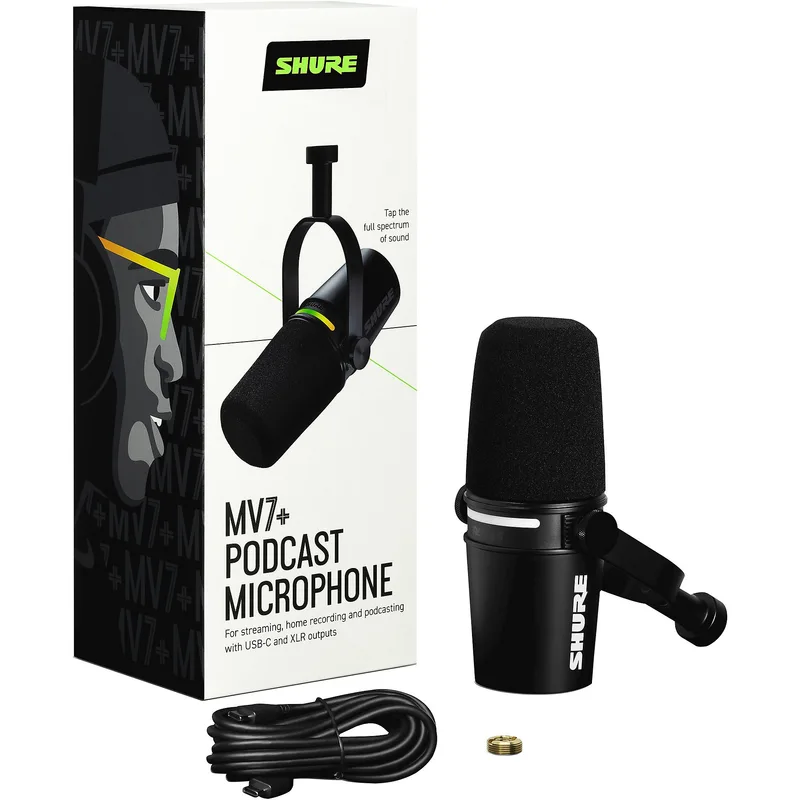
The Shure MV7+ is built around Auto Level Mode, and it’s the single feature that separates it from the PodMic USB in daily use. Auto Level Mode watches your voice in real time and adjusts gain automatically — so if you lean back, raise your voice, or move around during a call, the output stays level without you touching anything. Owner feedback consistently describes it as the closest thing to “set it and forget it” audio available in a USB mic.
The 32-bit float ADC adds headroom that 24-bit recording doesn’t have. If your voice spikes unexpectedly — a laugh, a raised point in a meeting — 32-bit float absorbs it instead of clipping. Combined with the LED touch panel showing input levels at a glance, the MV7+ gives you visual confirmation of your audio without opening any software.
At 1.21 lbs, the MV7+ is also considerably lighter than the PodMic USB, which matters if you’re mounting it on a lower-cost boom arm rated for lighter loads. The tradeoff is DSP depth: the MV7+ offers Auto Level Mode and not much else in terms of onboard tone-shaping. It handles the core problem — consistent, clean audio — extremely well, but doesn’t give you the compressor, noise gate, or exciter controls that Rode builds into the PodMic USB.
Who should buy this: Remote workers who want to plug in, set Auto Level Mode, and never think about gain again. Who should skip: Anyone who wants granular control over tone shaping — the PodMic USB’s DSP suite goes further.
Best Value: Rode PodMic USB
Rode PodMic USB
Pros
- APHEX DSP suite (noise gate, compressor, high-pass filter, Aural Exciter) gives deeper tone control than the MV7+'s Auto Level Mode alone
- Internal pop filter handles plosives without needing a separate foam windscreen
- All-metal build feels substantial and matches Rode's broadcast-mic durability reputation
- Wider 20Hz–20kHz frequency response captures more low-end body in the voice than the MV7+'s 50Hz–16kHz range
- Dual USB-C and XLR output offers the same upgrade path to an audio interface as the MV7+
Cons
- Gain-hungry design means quiet speakers may need to raise input levels more than with the MV7+
- Nearly a pound heavier than the MV7+, so lightweight boom arms may need a counterweight adjustment
- No Auto Level Mode or LED metering — relies on Rode Central software and manual gain instead of live visual feedback
- Owner reports flag occasional handling noise when stand-mounted on the same desk surface as a keyboard
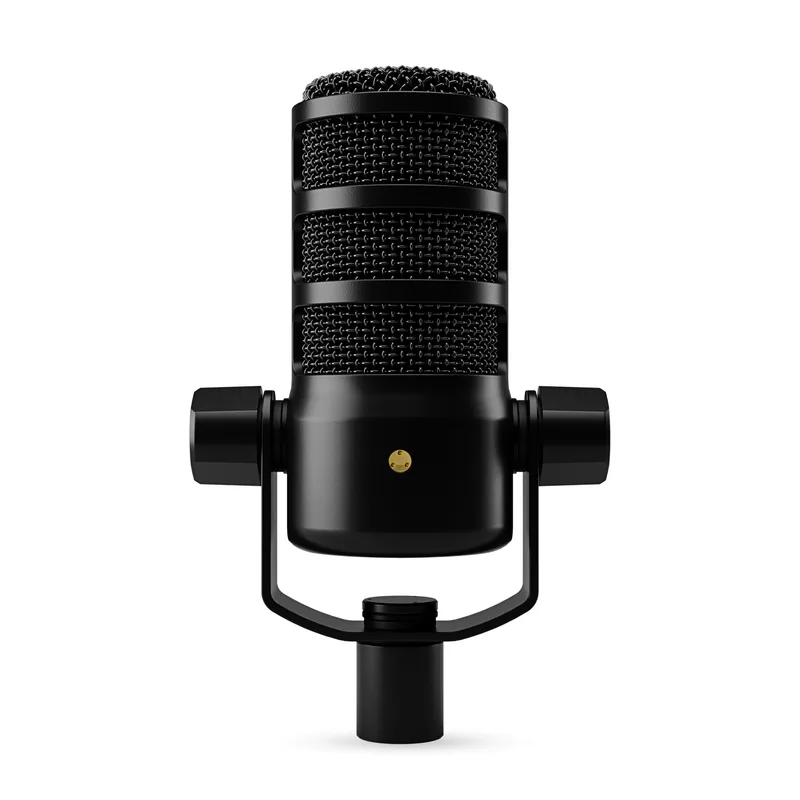
The Rode PodMic USB takes a different approach: instead of automating gain, it hands you a full DSP toolkit through Rode Central software — a noise gate, compressor, high-pass filter, and Aural Exciter for adding presence to a voice signal. For remote workers who want to tune their sound rather than trust an algorithm, this is meaningfully more capable than the MV7+‘s single Auto Level toggle.
The wider 20Hz–20kHz frequency response also gives the PodMic USB more low-end body than the MV7+‘s 50Hz–16kHz range, which owner reviews describe as a warmer, fuller voice signal out of the box. The internal pop filter is a nice touch too — no separate foam windscreen needed for plosive control on calls.
The catches are real, though. The PodMic USB is gain-hungry, meaning quiet speakers or anyone without a strong USB preamp upstream may need to push input levels higher than expected. At 2.07 lbs, it’s nearly a pound heavier than the MV7+, so a budget boom arm may need its counterweight adjusted. And without Auto Level Mode or an LED meter, you’re relying on Rode Central for visual feedback rather than glancing at the mic itself — less convenient mid-call.
Who should buy this: Remote workers who want deeper DSP control and don’t mind a one-time setup in Rode Central. Who should skip: Anyone who wants zero-configuration, glance-and-go audio — that’s the MV7+‘s job.
Which Mic Should You Buy?
Buy the Shure MV7+ if you want the least amount of audio fuss possible. Auto Level Mode and the LED panel mean you’re not opening software or adjusting gain before every call — plug in and it works.
Buy the Rode PodMic USB if you’re willing to spend ten minutes in Rode Central to configure the DSP suite, and you want more control over your final tone (or a lower price for the same dynamic noise rejection).
Buying Guide: What Matters With Dynamic USB Mics
Mic Distance
Both mics need you within 4–8 inches for full noise rejection. Sit too far back and the dynamic capsule that ignores room noise also starts ignoring your voice. A boom arm — not a low desktop stand — gets both mics positioned correctly without eating desk space.
Gain Source Matters
Dynamic mics generally need more gain than condensers to reach a usable signal level. The PodMic USB is noted as particularly gain-hungry; if your laptop’s built-in USB power or a passive hub struggles to drive it, plug directly into your machine rather than through a hub.
Automated vs Manual Gain
This is the real decision point between these two mics. Auto Level Mode on the MV7+ removes gain management from your workflow entirely. Rode Central’s DSP on the PodMic USB requires setup but gives you compressor, gate, and EQ-style controls the MV7+ doesn’t offer at all.
Boom Arm Weight Rating
Check your boom arm’s weight capacity before buying either mic, especially the PodMic USB at just over 2 lbs. An underrated arm will sag over time and drift out of the 4–8 inch sweet spot.
FAQ
Is the Shure MV7+ or Rode PodMic USB better for Zoom and Teams calls?
For most home offices, the Shure MV7+ is the easier choice for calls specifically — Auto Level Mode keeps your volume consistent without adjustment, which matters more in live calls than in recorded content. The PodMic USB can match that quality once configured in Rode Central, but it takes more setup.
Do I need Rode Central software to use the PodMic USB?
No — it works as a plug-and-play USB mic out of the box. But you’ll get meaningfully better results using Rode Central to configure the noise gate, compressor, and high-pass filter, since the mic ships without Auto Level Mode to compensate for an unconfigured signal chain.
Why is the Rode PodMic USB described as gain-hungry?
The dynamic capsule requires more amplification to reach a standard recording level than most condenser mics or even the MV7+. If your voice sounds quiet even at high USB gain settings, that’s expected — it’s a known tradeoff of the PodMic USB’s capsule design, not a defect.
Can I use either mic without a boom arm?
Technically yes, but not recommended. Both mics need to sit 4–8 inches from your mouth for the dynamic capsule to reject background noise properly, and desktop stands typically place the mic below that ideal position. Budget $25–$60 for a boom arm with either purchase.
Does the Shure MV7+ or Rode PodMic USB sound better out of the box?
The PodMic USB’s wider frequency response (20Hz–20kHz vs 50Hz–16kHz) tends to sound warmer and fuller unconfigured. The MV7+ sounds more consistent across a call because of Auto Level Mode, even if its raw frequency range is narrower.
Conclusion
Both mics solve the same home-office problem — background noise rejection — using the same dynamic-capsule approach, so the decision comes down to how much control you want over the process. The Shure MV7+ automates gain and gives you a cleaner, more hands-off experience for daily calls. The Rode PodMic USB costs less, sounds warmer with its wider frequency range, and gives you a genuine DSP toolkit if you’re willing to spend time in Rode Central.
Top pick: Shure MV7+ for remote workers who want zero-configuration consistency. Rode PodMic USB for anyone who wants more tone control at a lower price.
Detailed Reviews
Shure MV7+
Pros
- Auto Level Mode adjusts gain automatically, so voice stays consistent without touching a dial mid-call
- 32-bit float recording prevents clipping even when you raise your voice or laugh loudly
- Lighter and more compact than the PodMic USB, easier to mount on a standard boom arm
- LED touch panel gives real-time input metering and one-touch mute visible from across the desk
- Dual USB-C and XLR output supports upgrading to an audio interface later without replacing the mic
Cons
- No onboard DSP suite beyond Auto Level Mode — less deep tone-shaping control than Rode Central offers
- $269+ street price sits well above the PodMic USB at typical Amazon pricing
- Cardioid-only pickup pattern, no alternate modes for group recording
Rode PodMic USB
Pros
- APHEX DSP suite (noise gate, compressor, high-pass filter, Aural Exciter) gives deeper tone control than the MV7+'s Auto Level Mode alone
- Internal pop filter handles plosives without needing a separate foam windscreen
- All-metal build feels substantial and matches Rode's broadcast-mic durability reputation
- Wider 20Hz–20kHz frequency response captures more low-end body in the voice than the MV7+'s 50Hz–16kHz range
- Dual USB-C and XLR output offers the same upgrade path to an audio interface as the MV7+
Cons
- Gain-hungry design means quiet speakers may need to raise input levels more than with the MV7+
- Nearly a pound heavier than the MV7+, so lightweight boom arms may need a counterweight adjustment
- No Auto Level Mode or LED metering — relies on Rode Central software and manual gain instead of live visual feedback
- Owner reports flag occasional handling noise when stand-mounted on the same desk surface as a keyboard