The premium work headset market shifted noticeably in March 2026. Jabra launched the Evolve3 85 at $649, ditching the retractable boom microphone in favor of a boomless, consumer-style design with ClearVoice AI voice isolation. That release created a sharp value question for anyone shopping at the top of the work headset market: does the Evolve2 85 still justify $449, or has its own successor already made it obsolete?
The Evolve2 85 has been available since 2020. Six years is a long time in any category. But it remains Jabra’s only UC-certified over-ear headset with a physical boom microphone, a 37-hour battery, and a 30-meter wireless range — a combination that no competitor, including the Evolve3 85, has matched in a single package.
For workers whose day consists primarily of video calls, the Evolve2 85’s case is still strong.
Who This Headset Is For
The Evolve2 85 was built for a specific kind of remote worker: someone on calls for 6–8 hours a day who needs clear voice pickup in an imperfect home environment, doesn’t want to think about charging more than once a week, and values the freedom to move around the house between meetings.
The 10-mic boom array addresses the biggest failure mode of consumer headphones used for work — the mic picks up everything in the room, not just your voice. The 37-hour battery eliminates the daily charging cycle. The 30-meter range means you can step into another room during a call without dropping audio.
If your day is split evenly between calls and focused listening, and you want a headset that looks like premium consumer headphones on and off calls, the Evolve3 85 is a better fit. If your primary need is call quality and battery duration at a more defensible price, the Evolve2 85 still leads.
Quick Comparison
| Jabra Evolve2 85 | Jabra Evolve3 85 | Poly Voyager Focus 2 | |
|---|---|---|---|
| Price | $449 | $649 | $249 |
| Mic type | Retractable boom (10 mics) | Boomless ClearVoice AI | Retractable boom (3 mics) |
| Call battery | 37 hours (ANC on) | 25 hours | 16 hours (ANC on) |
| Weight | 286g | Not published | 175g |
| ANC | On/off toggle | Adaptive real-time | Active hybrid |
| Wireless range | 30m | 30m | 30m |
| UC certified | Yes | Yes | Yes |
| Launch price | $449 | $649 | $249 |
Jabra Evolve2 85: In Depth
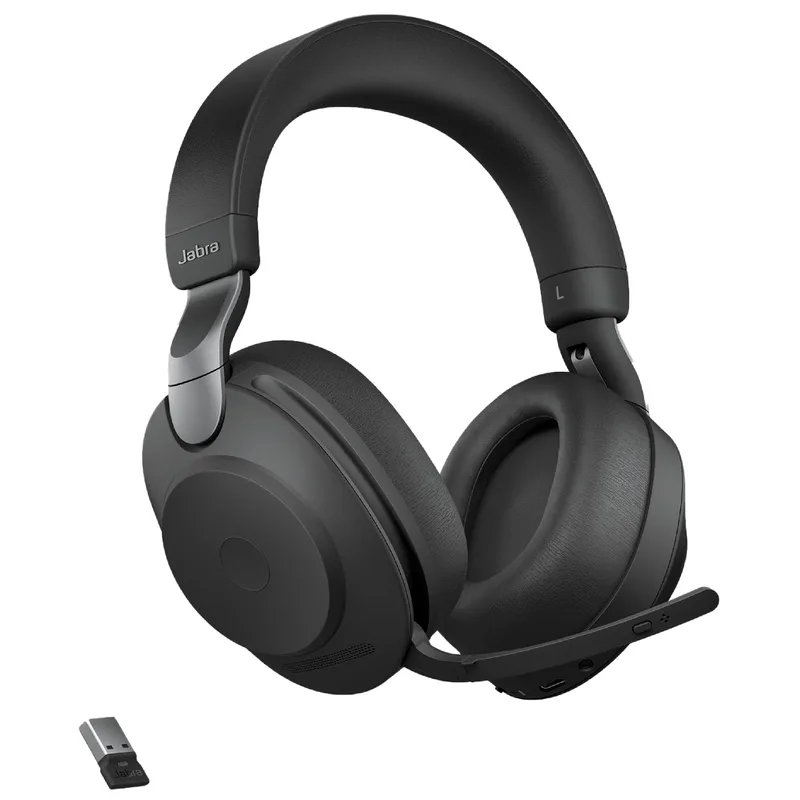
Microphone Performance
The retractable boom mic is the Evolve2 85’s defining feature. The 10-mic array — 6 digital MEMS and 4 analog MEMS microphones — captures voice within a directional pattern while suppressing background sound. Based on user reports across major review sites, call recipients consistently cannot detect household noise even when the Evolve2 85 is used in kitchens, shared living spaces, or near HVAC systems.
The boom arm retracts flush with the headband when not needed. Extending it activates the microphone automatically on most UC platforms — a practical detail when you’re toggling between calls and focused work throughout the day. The microphone frequency range spans 100Hz–8,000Hz for digital channels, capturing voice clearly without excessive high-frequency harshness.
Compared to consumer headphones like the Sony WH-1000XM5, which rely on built-in array mics, the Evolve2 85’s boom delivers better directional isolation on calls. The Sony’s microphone is usable for occasional calls but picks up significantly more ambient noise when your home office has any background activity.
Active Noise Cancellation
The digital hybrid ANC reduces ambient noise, with Jabra’s specification claiming 54% more noise cancellation versus earlier Evolve-series products. Based on user reports, the ANC performs well on continuous low-frequency sounds — HVAC hum, road traffic, appliance noise — but trails dedicated consumer ANC headphones like the Sony WH-1000XM5 or Bose QuietComfort Headphones on variable or high-frequency noise.
The on/off toggle is the clearest limitation compared to 2026 competition. The Evolve3 85’s adaptive ANC adjusts in real time without user input. For users who want granular control — or who work in environments with changing noise levels throughout the day — this gap is meaningful.
That said, the boom mic’s noise rejection compensates for the ANC gap on calls. Your colleagues aren’t affected by ambient sound even when your ear cups don’t fully suppress it. The ANC is primarily for your own focus, not for call quality.
Battery Life
37 hours with ANC active is the specification most often cited by long-term users when explaining why they chose the Evolve2 85. At 8 hours of daily use, that’s more than four days between charges. The 15-minute quick charge that delivers 8 hours is genuinely useful on mornings when you forgot to plug in.
The charging stand (sold separately or included in bundle variants) simplifies overnight charging without fumbling with a cable. Drop the headset on the stand each evening — it’s ready the next morning.
The Poly Voyager Focus 2 offers 16 hours with ANC on, requiring daily charging for full-day users. The Evolve3 85’s 25 hours is more comfortable but still 12 hours short of the Evolve2 85.
Comfort and Weight
At 286g, the Evolve2 85 is heavier than most competitors. The Poly Voyager Focus 2 weighs 175g — a 111g difference that becomes perceptible over a long workday. Jabra addresses this with a suspension-style headband that distributes pressure across the skull rather than concentrating it at the top. The memory foam ear cushions seal well and remain soft over extended sessions.
User reports generally describe the fit as comfortable for 6–8 hour wear. Some note fatigue during unusually long days above 8 hours. If you routinely wear a headset for 10+ consecutive hours, the Voyager Focus 2’s lower weight is worth considering.
Software and Connectivity
Jabra Direct (Mac and Windows) handles firmware updates, EQ adjustments, and ANC configuration. It’s reliable and straightforward. The busylight — a red LED ring on the headband that activates during calls — is a small but practical feature for shared living situations.
Bluetooth multipoint supports two simultaneous connections. The most common setup: USB dongle connected to a laptop for calls, Bluetooth paired directly to a smartphone for audio when not on calls. Switching between them is automatic.
Variant note: The UC variant works across Zoom, Google Meet, Cisco Webex, and Microsoft Teams. The MS Teams variant adds a dedicated Teams button and Teams-specific call controls. For anyone using more than one conferencing platform, the UC version is the more flexible choice.
The Alternatives
Jabra Evolve3 85 — The Upgrade Path
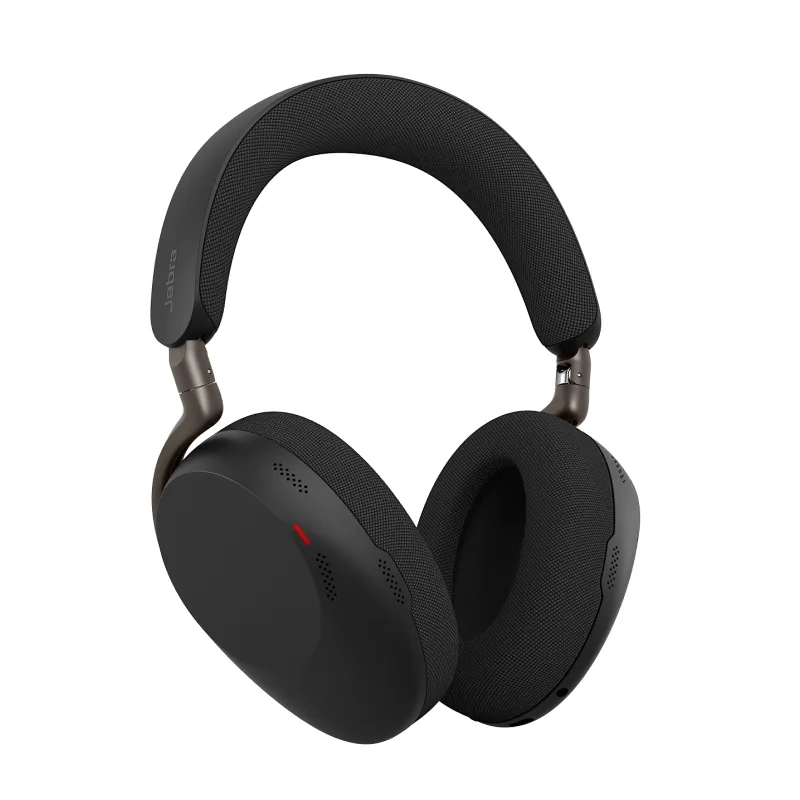
The Jabra Evolve3 85 at $649 represents Jabra’s vision for the next generation of professional headsets. The boom microphone is gone — ClearVoice AI technology handles voice isolation using embedded microphones in the ear cups. Adaptive real-time ANC replaces the on/off toggle. Wireless charging, a premium industrial design, and a 120-hour music battery reposition it as an everyday headphone that happens to be certified for work.
The trade-offs are significant: 25 hours of call battery (vs 37), $200 more, and voice isolation that depends on AI processing rather than physical microphone proximity. TechRadar’s early review describes it as “professional audio engineered for modern work and play” — which is precisely the point. It serves a broader use case than a dedicated call headset.
For workers who want one device for calls, focus listening, and commuting, the Evolve3 85 is worth the premium. For workers whose priority is maximizing call quality and battery between charges, the Evolve2 85 delivers more where it counts.
Poly Voyager Focus 2 UC — The Value Alternative
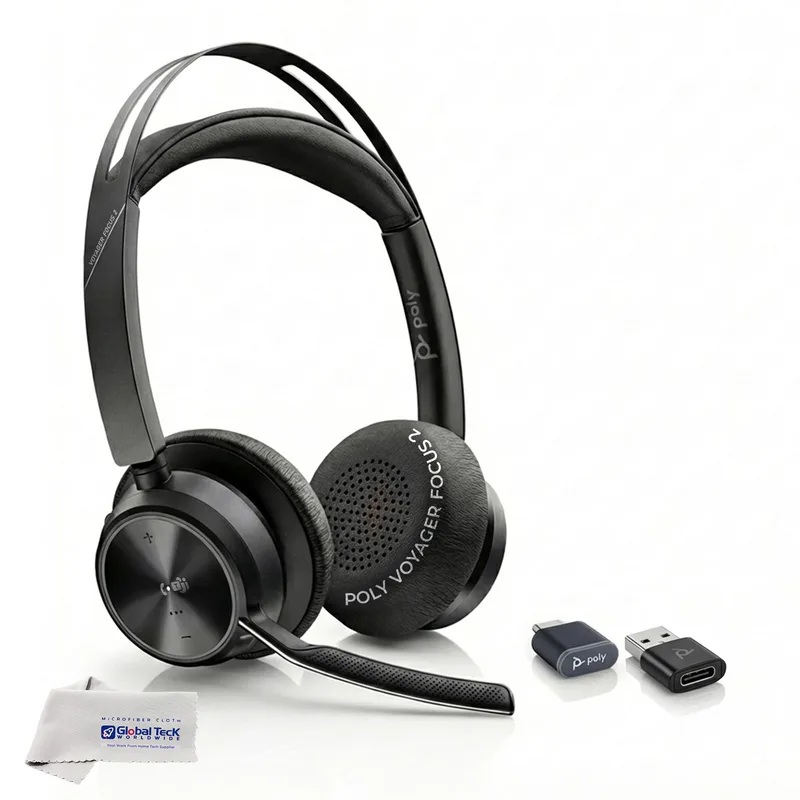
The Poly Voyager Focus 2 UC at $249 is the strongest mid-range option. The boom mic uses a 3-mic array (vs 10 on the Jabra), and battery with ANC active is 16 hours — about two call days instead of four or more. But at roughly half the Evolve2 85’s price, it covers the essential remote work use case: UC certified, boom mic, wireless, active noise cancellation.
At 175g, it’s meaningfully lighter — a practical advantage for workers where weight matters more than battery duration or mic array sophistication. Plantronics Hub software is functional but less refined than Jabra Direct.
Buying Guide
If your day is mostly calls in a noisy environment: The Evolve2 85’s boom mic and 37-hour battery is the right combination. The directional mic isolation compensates for the gap in ANC performance when background noise is high.
If you want Jabra’s newest technology: The Evolve3 85 is already available. Budget $649 and accept fewer call hours and no physical boom mic. The adaptive ANC and wireless charging are genuine improvements, but they come at a real cost.
If $449 is more than you want to spend: The Poly Voyager Focus 2 UC at $249 covers the critical requirements — boom mic, UC certified, ANC — with the primary trade-off being shorter battery life and a less sophisticated mic array.
If you’re split between calls and listening: Consumer headphones with better ANC (Sony WH-1000XM5, Bose QuietComfort Headphones) provide better music listening at similar prices, but lack boom mics and UC certifications. The Evolve3 85’s dual positioning addresses this, but at $649.
UC vs MS Teams variant: For dedicated Teams users, the Teams variant adds one-button call controls and Teams-specific functions. For Zoom, Meet, or multi-platform users, the UC variant is the correct choice.
FAQ
Is the Jabra Evolve2 85 worth $449 in 2026? For heavy call users — 4+ hours of video calls per day — yes. The 37-hour battery and 10-mic boom mic combination is difficult to match at any price. If you’re on calls less than 2 hours daily, the Jabra Evolve2 65 at $199 covers the essentials without the premium.
What’s the difference between the UC and MS Teams versions? The UC variant is compatible with all major platforms: Zoom, Google Meet, Cisco Webex, and Teams. The MS Teams variant adds a dedicated Teams button and optimized call controls for the Teams platform. For single-platform Teams users, the Teams version is more convenient. For everyone else, UC is more practical.
How does the Evolve2 85 microphone compare to a laptop’s built-in mic? The difference is significant. The retractable boom mic positions close to your mouth with directional pickup to isolate your voice from room noise. Laptop built-in mics are omnidirectional, picking up keyboard clicks, fan noise, and ambient sound alongside voice. Call recipients notice the difference immediately on any platform.
Does the Evolve2 85 work without the USB dongle? Yes — it connects via standard Bluetooth to any device. The USB dongle provides lower latency and more reliable connectivity, particularly on Windows machines with inconsistent built-in Bluetooth. For calls where audio reliability matters, using the dongle is recommended.
Should I buy the Evolve2 85 or wait for the Evolve3 85? The Evolve3 85 is already available at $649. The question is whether boomless AI mic, adaptive ANC, and wireless charging justify $200 more and 12 fewer hours of call battery. For call-focused workers, the Evolve2 85 remains the stronger practical choice. For workers who also want a premium listening headphone, the Evolve3 85 is worth the step up.
Conclusion
The Jabra Evolve2 85 at $449 holds up in 2026 — not because it’s new, but because its combination of 10-mic boom mic, 37-hour battery, and 30-meter range remains unmatched at its price for call-focused work.
The Jabra Evolve3 85 represents the future direction of the product line, but it costs $200 more for fewer call hours and no physical boom mic — a genuine trade-off for workers whose day is primarily calls.
For those who can stretch to $449, the Jabra Evolve2 85 is the call-focused headset to beat. If $249 is the ceiling, the Poly Voyager Focus 2 UC covers the essentials at half the price with a lighter frame.
Detailed Reviews
Jabra Evolve2 85 UC
Pros
- 37-hour battery with ANC active outlasts any comparable work headset — a full week of 8-hour call days without reaching for the charger
- 10-mic array boom mic delivers clear voice isolation in noisy home offices, with UC and MS Teams certified variants
- 30-meter wireless range lets you move freely around your home during calls without signal drops
- Bluetooth multipoint connects two devices simultaneously — switch between laptop and phone without re-pairing
- Busylight indicator on the headband signals do-not-disturb to household members during calls
Cons
- At 286g, noticeably heavier than the Poly Voyager Focus 2 (175g) — fatigue is possible on very long wear days
- ANC has only on/off — no granular adjustment levels like High/Medium/Low found on consumer headphones
- Retractable boom mic is more fragile than boomless designs over years of daily use
Jabra Evolve3 85
Pros
- Boomless design with ClearVoice AI technology — professional certification in consumer headphone form
- Wireless charging and fast charge (10 minutes for 10 hours) simplify daily charging management
- Adaptive ANC adjusts to your environment in real time rather than a fixed on/off toggle
- 120-hour music battery means it functions as your everyday headphones, not just a dedicated work headset
Cons
- $649 launch price is $200 more than the Evolve2 85 for 12 fewer hours of call battery
- No retractable boom mic — voice isolation depends entirely on AI processing, which may underperform in extreme noise
- Very new as of March 2026 — limited long-term reliability data compared to the Evolve2 85's multi-year track record
Poly Voyager Focus 2 UC
Pros
- Lightest of the three at 175g — noticeably more comfortable for very long wear sessions
- UC certified and Teams/Zoom compatible at roughly half the Evolve2 85's price
- Boom mic with ANC covers the core requirements for remote call work at a mid-range budget
Cons
- 16-hour ANC battery requires daily charging for most full-day call users
- 3-mic boom array is less sophisticated than the Evolve2 85's 10-mic configuration
- Plantronics Hub software is less polished than Jabra Direct for configuration and firmware management