CES 2026 pushed tri-color laser light engines, once a $3,000-plus home theater feature, down into $400-$800 portable projectors. Two projectors on this list — the XGIMI Halo+ and the Nebula Capsule 3 Laser — carry that shift directly: better color and detail in a body small enough to carry between meetings, at prices that would have bought a dim LED unit two years ago. For home office use, that matters less for movie night and more for whether a projected slide deck actually reads clearly in a room with the lights on.
Presenting from a home office setup, a coworking space, or a client’s conference room has different needs than a home theater projector. Brightness in a lit room matters more than contrast ratio. Setup speed matters more than sound stage. And whether it runs on battery or needs an outlet determines whether it’s a desk fixture or something you can actually carry.
Quickest answer: The Epson EpiqVision Flex CO-W01 ($329.99) is the best pick if presentations happen mostly in one room with an outlet nearby — its 3,000 lumens beats every battery-powered option here for readability in a lit space. The XGIMI Halo+ ($449.00) is the better all-around choice if you need to move between rooms or locations, thanks to its built-in battery and fast auto-setup. The Nebula Capsule 3 Laser ($599.99) is the one to pack when size is the deciding factor.
Quick Comparison
| Projector | Price | Brightness | Battery | Weight | Rating |
|---|---|---|---|---|---|
| Epson EpiqVision Flex CO-W01 | $320.00-$329.99 as of Oct 11, 2026 | 3,000 lumens | None (AC only) | 5.3 lbs | 9.0/10 |
| XGIMI Halo+ | $424.00 as of Oct 11, 2026 | 900 ANSI lumens | 2.5 hrs | 3.5 lbs | 8.8/10 |
| ViewSonic M2e | Unavailable | 1,000 LED lumens | None (USB-C bank) | 2.2 lbs | 8.3/10 |
| Nebula Capsule 3 Laser | $599.99 as of Oct 11, 2026 | 300 ANSI lumens | 2.5 hrs | 2.1 lbs | 8.1/10 |
| ASUS ZenBeam L2 | $561.95-$699.00 as of Oct 11, 2026 | 960 LED lumens | 3.5 hrs | 1.57 lbs | 7.9/10 |
The 5 Best Portable Projectors for Home Office Presentations
1. Epson EpiqVision Flex CO-W01 — Editor’s Pick
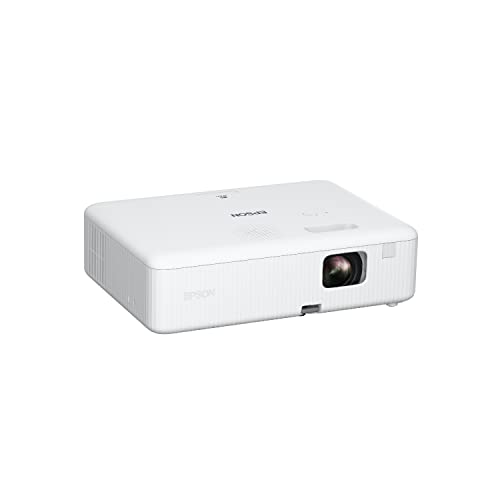
This is the brightest projector on the list by a wide margin, and for slide presentations that’s the number that matters most. At 3,000 lumens, it stays readable in a room with overhead lights on or a window letting in daylight — something none of the battery-powered options here can manage. The 3-chip 3LCD engine also avoids the faint rainbow artifact some single-chip DLP projectors show on high-contrast white slide backgrounds.
The tradeoff is that this is a plug-in projector, not a portable one in the battery sense. It runs on AC power only, so it’s built for a desk, a home office corner, or a conference room with an outlet nearby, not for carrying between client sites during the day. HDMI, USB Display, and USB media inputs cover most laptop and thumb-drive scenarios without extra adapters, and the 12,000-hour eco-mode lamp life means this isn’t a bulb you’ll be replacing anytime soon. At $329.99, it’s also the cheapest projector on this list.
2. XGIMI Halo+ — Best Overall
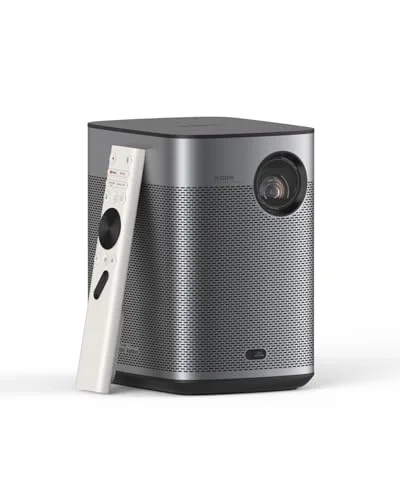
The Halo+ is the pick if you actually need to move between rooms or locations during the day. Its built-in 59.454Wh battery runs up to 2.5 hours, enough for a morning of back-to-back meetings without an outlet, and auto keystone, autofocus, and obstacle avoidance mean it takes seconds to get a clean image on a wall instead of manual adjustment before every call.
Harman Kardon speakers with Dolby Audio are loud and clear enough to serve as the room’s audio for a hybrid call, which saves carrying a separate speaker. Google TV with Chromecast built in also means a slide deck can stream directly from Google Slides or a cloud drive without a laptop tethered to it. The catch is brightness on battery power drops from its AC-powered rating, so for a genuinely bright room, plan to plug in. At 3.5 lbs it’s also the bulkiest of the battery-powered options here.
3. ViewSonic M2e — Best Color Accuracy
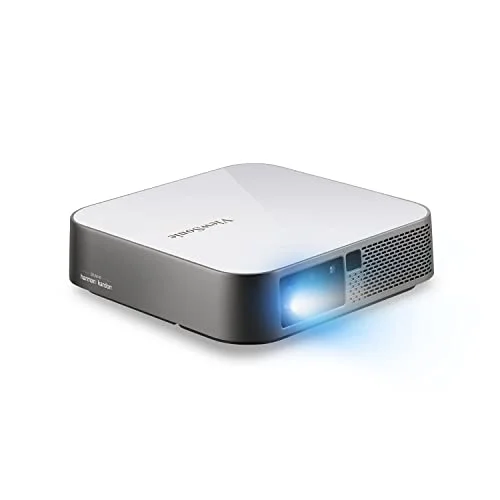
For presentations built around design work, product photography, or brand colors a client will scrutinize, the M2e’s 125% Rec.709 color coverage is the standout spec on this list — nothing else here matches it for color fidelity. Instant autofocus and automatic H/V keystone correction handle setup even when the projector is sitting at an angle instead of dead-center to the wall.
It has no built-in battery, but it’s compatible with a 65W USB-C power bank, which gives a cordless option without the bulk of carrying a projector with an internal battery built in. WiFi screen mirroring casts from a laptop or phone without a cable. The two real drawbacks: fan noise is noticeable at full brightness (eco mode is the more comfortable setting for a quiet room), and wireless casting can lag audio and video sync by several seconds — distracting on anything video-heavy.
4. Nebula Capsule 3 Laser — Most Portable
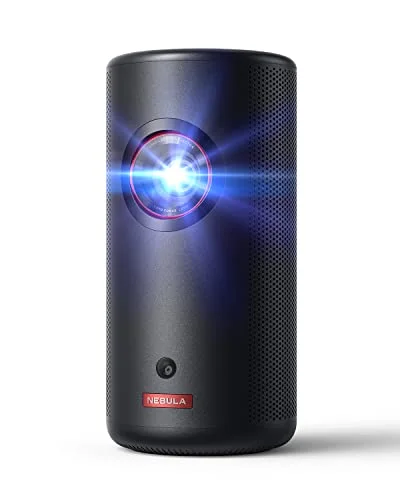
Shaped like a soda can and weighing 2.1 lbs, this is the projector that actually disappears into a bag for someone presenting from a different location every week. The laser light source is the meaningful upgrade over the previous Capsule generation — it holds detail and color noticeably better than an LED engine of the same size, part of the broader shift toward laser engines in compact projectors this year.
At 300 ANSI lumens, though, it’s also the dimmest projector on this list, which limits it to genuinely dim rooms — daytime office use with the lights on will wash out the image. Native Netflix support works out of the box, unlike the XGIMI Halo+, and tripod-mount threading on the base makes it easy to angle on an awkward conference table. Dual fans get audible up close, and the 8W speaker is better paired with a room’s existing speaker system than relied on alone.
5. ASUS ZenBeam L2 — Best Battery Life
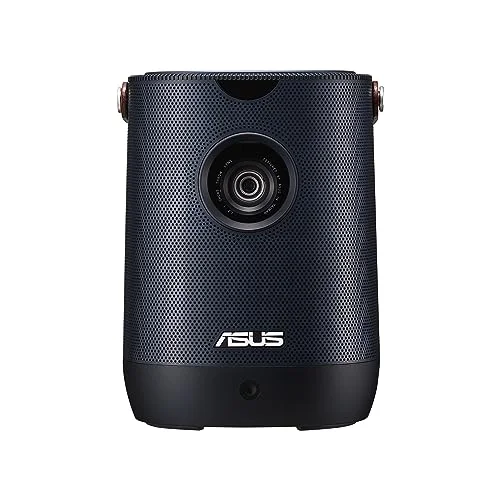
If a full afternoon of meetings without recharging is the priority, the ZenBeam L2’s 65Wh battery delivers close to 3 hours of real-world runtime in mid brightness mode — the longest of any projector here. At 1.57 lbs it’s also the lightest, and it ships with a travel case most competitors skip.
The catch is that brightness and runtime trade off directly: the brightest setting drains the battery fastest, so getting the full 3 hours means dialing brightness back, which isn’t ideal in a lit room. Color reproduction is competitive with pricier options on this list, and Android TV built in pulls a deck from cloud storage without a laptop. Input lag is high enough that this is a slide-and-video projector rather than anything interactive. At $688.92, it’s also the priciest pick here — the premium buys battery life, not brightness.
Buying Guide: Choosing a Portable Projector for Presentations
Brightness matters more than resolution for slide decks. A dim 4K projector reads worse in a lit room than a bright 1080p one. For business presentations, prioritize ANSI or LED lumens over resolution — most slide content doesn’t need more than 1080p anyway.
Decide whether you actually need a battery. If presentations happen in one location with an outlet available, a plug-in projector like the Epson gets you far more brightness per dollar. A battery only earns its keep if you’re genuinely moving between rooms or sites during the day.
Check the light source, not just the lumens. Laser and LED light sources last tens of thousands of hours and don’t dim the way lamp-based projectors do over time. A lamp-based projector like the Epson trades that longevity for significantly higher peak brightness at a lower price — a reasonable tradeoff for a desk-bound unit.
Auto keystone and autofocus save real setup time. Presenting on a tight schedule doesn’t leave room for manually squaring an image before a call starts. Every battery-powered projector on this list includes both; check for them specifically if buying something not on this list.
Built-in speakers are good enough for small rooms, not conference rooms. A projector’s onboard speaker works for a huddle of two or three people. For a larger room, plan to connect a Bluetooth speaker or use the room’s existing audio system.
Screen mirroring beats carrying an HDMI cable everywhere. WiFi casting or a built-in smart TV OS (Google TV, Android TV) means one less cable to pack and one less port compatibility issue with a client’s laptop.
Frequently Asked Questions
Do I need a laser projector for business presentations?
Not necessarily. Laser and LED light sources last far longer than traditional lamps and hold color better at small sizes, but a bright lamp-based projector like the Epson EpiqVision Flex CO-W01 can outperform a dim laser pico projector for straightforward slide readability in a lit room.
How bright does a projector need to be for a lit conference room?
Aim for at least 1,000 lumens if there’s any ambient light in the room, and closer to 3,000 lumens if the room has windows or overhead lighting you can’t dim. Anything under 500 lumens is realistically a dim-room-only projector.
Can I run a battery-powered projector off a USB-C power bank instead?
Some can. The ViewSonic M2e specifically supports a 65W USB-C power bank as an alternative to AC power, which is worth checking on any projector without a built-in battery before assuming you’re tied to an outlet.
Is 1080p resolution enough for presentations?
Yes. Slide decks, spreadsheets, and most video content look fine at 1080p, and it’s the native resolution on most of this list. Higher resolution matters more for detailed photo or video work than for a typical business presentation.
How loud are portable projector fans in a quiet meeting room?
Noticeable, especially at full brightness. Several projectors on this list — the ViewSonic M2e and Nebula Capsule 3 Laser among them — are quieter in eco or lower brightness modes, which is worth using by default in a small, quiet room.
Bottom Line
For most home office presentations, the Epson EpiqVision Flex CO-W01 at $329.99 is the right default — its 3,000 lumens beats every other projector on this list for readability in a lit room, and it costs the least. If presentations happen across multiple rooms or locations, the XGIMI Halo+ at $449.00 is the better fit, trading some brightness for a built-in battery and near-instant auto setup. And if packing light is the deciding factor, the Nebula Capsule 3 Laser at $599.99 is small enough to disappear into a bag without giving up laser-grade color.
Detailed Reviews
Epson EpiqVision Flex CO-W01
Pros
- 3,000 lumens is bright enough to read slides in a partially lit conference room, where every battery-powered pico projector on this list struggles
- 3-chip 3LCD engine produces accurate color without the rainbow artifacts some single-chip DLP projectors show on white slide backgrounds
- HDMI, USB Display, and USB media inputs cover a laptop, a thumb drive, or a direct plug-and-play file share without extra adapters
- Built-in 5W speaker is loud enough for a small conference room without a separate speaker
- Lamp rated for 12,000 hours in eco mode, so it isn't a wear item you'll think about for years
Cons
- No battery — this runs on AC power only, so it's a presentation projector you set up at a desk or in a meeting room, not one you carry between locations mid-day
- WXGA native resolution (1280x800) upscales 1080p input rather than displaying it natively, which is fine for slides but a step down for detailed video
- No built-in smart TV apps, so streaming a deck from the cloud requires a laptop or streaming stick plugged into HDMI
XGIMI Halo+
Pros
- Built-in battery means you can walk into a client's office or a coworking space and present without hunting for an outlet
- Auto keystone, autofocus, and intelligent obstacle avoidance get an image square on the wall in seconds instead of manual focus fiddling before a call
- Harman Kardon speakers are loud and clear enough to double as the room's audio for a hybrid meeting, not just projector sound
- Google TV with Chromecast built in pulls a slide deck straight from Google Slides or a cloud drive without a laptop tethered by HDMI
- Doubles as a genuinely good movie projector after hours, so it isn't a single-purpose office expense
Cons
- Brightness drops noticeably on battery power — plan to plug in for anything brighter than a dim meeting room
- No native Netflix app is a minor annoyance for personal use, though irrelevant for slide presentations
- At 3.5 lbs it's bulkier than the dedicated pico projectors on this list, closer to a small book than a phone
ViewSonic M2e
Pros
- 125% Rec.709 color coverage is the most accurate on this list, which matters when a presentation includes brand colors, product photos, or design mockups a client will scrutinize
- Instant autofocus and auto H/V keystone correct the image automatically when you set it down at an angle
- USB-C power bank compatibility (65W) gives you a cordless option without carrying the bulk of a projector with a built-in battery
- WiFi screen mirroring casts directly from a laptop or phone without a cable
- 30,000-hour LED light source outlasts lamp-based projectors by a wide margin
Cons
- No internal battery — you need AC power or a compatible 65W power bank on hand, which is one more thing to remember to pack
- Fan noise is noticeable at full brightness; eco mode is the more comfortable setting for a quiet meeting room
- Wireless casting can lag audio and video sync by several seconds, which is distracting during a video-heavy deck
Nebula Capsule 3 Laser
Pros
- Small enough to fit in a bag's water bottle pocket, the most travel-friendly option here for someone presenting from a different location each week
- Laser light source holds detail and color better than an LED engine of the same size, a step up from the previous Capsule generation
- Native Netflix support works out of the box, unlike the XGIMI Halo+, which needs a workaround
- Autofocus re-corrects the image automatically when you move it between rooms during the day
- Tripod-mount threading on the base makes it easy to angle for an awkward conference table setup
Cons
- 300 ANSI lumens is the dimmest projector on this list — it needs a genuinely dim room to read clearly, which rules out most daytime office use
- Dual fans measured around 38.6dBA up close, noticeable in a quiet meeting room
- 8W speaker is thin on bass and best paired with the room's existing speaker or a Bluetooth speaker for anything beyond a small huddle
ASUS ZenBeam L2
Pros
- Longest real-world battery runtime in this group at nearly 3 hours in mid brightness mode, enough to cover a full afternoon of back-to-back meetings
- Included travel case keeps it protected between locations, a nice touch competitors leave out
- Color reproduction holds up well for the price, competitive with pricier options here
- Android TV built in pulls a deck from cloud storage without a laptop plugged in
- At 1.57 lbs, it's the lightest projector on this list despite the largest battery
Cons
- Highest price on this list, and the premium buys battery life more than brightness
- Brightness and runtime trade off directly — the brightest mode drains the battery fastest, so expect to dial it back for longer sessions
- Input lag is high enough that it's a slide-and-video projector, not one you'd want for anything interactive