| Spec | Shure MV7+ | Blue Yeti X | Shure MV7 | Rode NT-USB Mini |
|---|---|---|---|---|
| Rating | 9.0/10 | 8.2/10 | 8.0/10 | 7.8/10 |
| Price | $269.77-$299.00as of Oct 18, 2026 | Unavailable | $288.00-$299.00as of Oct 18, 2026 | $97.85-$103.00as of Oct 18, 2026 |
| Type | Dynamic (XLR + USB-C) | Condenser (USB-A) | Dynamic (XLR + USB-A) | Condenser (USB-C) |
| Polar Pattern | Cardioid | — | Cardioid | Cardioid |
| Frequency Response | 50Hz–16kHz | 20Hz–20kHz | 50Hz–16kHz | 20Hz–20kHz |
| Bit Depth / Sample Rate | 32-bit float / 48kHz | 24-bit / 48kHz | 24-bit / 48kHz | 24-bit / 48kHz |
| Connectivity | USB-C + XLR | USB-A | USB-A + XLR | USB-C |
| Monitoring | Zero-latency headphone jack | Zero-latency headphone jack | 3.5mm headphone jack | 3.5mm headphone jack |
| Controls | LED touch panel, Auto Level Mode | Smart knob (gain/headphone/pattern), 11-LED meter | Touch mute panel, gain/monitor controls | Integrated pop filter, compact desktop stand |
| Weight | 0.55 kg (1.21 lbs) | 1.22 kg (2.68 lbs) | 0.55 kg (1.21 lbs) | 0.32 kg (0.71 lbs) |
| Polar Patterns | — | Cardioid, Stereo, Omnidirectional, Bidirectional | — | — |
| Check Price → | Check Price → | Check Price → | Check Price → |
Prices change daily — tap Check Price for the current Amazon price.
Disclosure: SetupRanked earns a commission on purchases made through links on this page, at no extra cost to you.
The Shure MV7+ launched with a 32-bit float ADC, USB-C, and Auto Level Mode — features that change the calculus considerably compared to the original MV7. Comparing Blue Yeti X vs Shure MV7 in 2026 is really a choice between condenser vs dynamic mic design, and that choice matters more than brand. Quick pick: the Shure MV7+ wins for most home offices; the Blue Yeti X wins if you have a treated room and need pickup pattern flexibility. This guide breaks down exactly which mic wins for your specific setup.
Quick Comparison
| Shure MV7+ | Blue Yeti X | Shure MV7 | Rode NT-USB Mini | |
|---|---|---|---|---|
| Type | Dynamic | Condenser | Dynamic | Condenser |
| Price | $269–$319 | $129–$149 | $136–$149 | $89–$99 |
| Noise Rejection | Excellent | Poor | Excellent | Poor |
| Polar Patterns | Cardioid only | 4 patterns | Cardioid only | Cardioid only |
| Connectivity | USB-C + XLR | USB-A | USB-A + XLR | USB-C |
| Auto Level | Yes | No | No | No |
| Best For | Untreated rooms | Treated studios | Budget dynamic | Travel/compact |
The Core Difference: Dynamic vs Condenser
Every meaningful difference in this comparison traces back to capsule type.
Condenser microphones (Blue Yeti X, Rode NT-USB Mini) use an electrically-charged diaphragm that’s highly sensitive across the full audio spectrum. They capture rich, detailed voice recordings — and they capture everything else in the room too. Keyboard typing, mechanical switches, an HVAC system cycling on, someone walking past the office door. In a treated room or studio with acoustic panels, condensers sound exceptional. In a typical home office with hard surfaces, an open-plan layout, or background noise from a city or family, they’re a liability.
Dynamic microphones (Shure MV7+, Shure MV7) work differently. The diaphragm is heavier and requires the sound source to be close and direct. Sound arriving at angles or from a distance simply doesn’t move the diaphragm enough to register. That’s not a limitation — it’s a feature. Your mechanical keyboard at 12 inches sits at the angle the mic ignores. The Shure MV7+ records your voice clearly while the same background noise that ruins a condenser recording becomes inaudible.
The verdict for remote work in 2026: most home offices are better served by a dynamic mic. Only if you have acoustic treatment, a quiet environment, or a specific need for stereo/omnidirectional recording does the condenser advantage apply.
Best for Home Offices: Shure MV7+
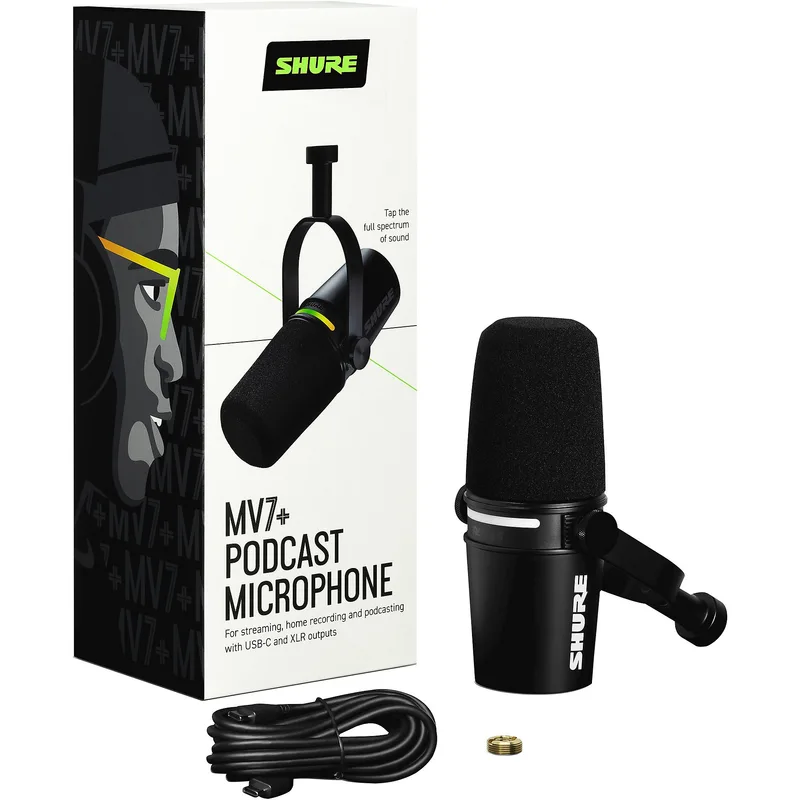
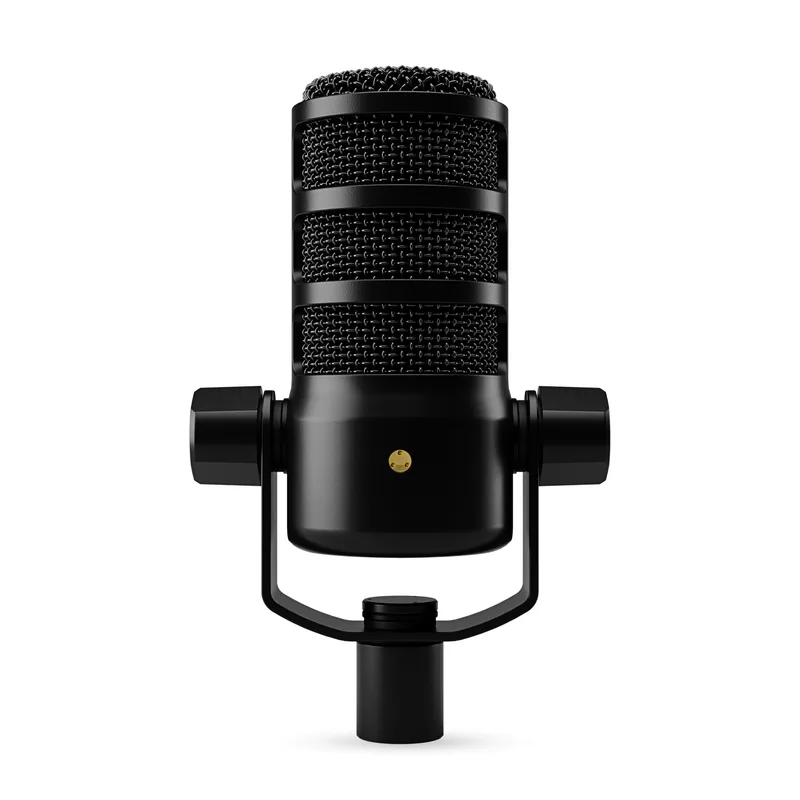
Shure MV7+
Pros
- Dynamic capsule naturally rejects keyboard noise, HVAC hum, and off-axis sound — critical for untreated home offices
- Auto Level Mode keeps your voice at consistent volume without touching the gain dial
- 32-bit float recording prevents clipping even during loud moments like laughing or raised voice
- LED touch panel provides real-time metering and one-touch mute — visible from across the desk
- Dual USB-C and XLR output means you can use it now as USB and later with an audio interface
Cons
- Cardioid-only — no stereo or omnidirectional modes for recording music or multi-speaker meetings
- $299 street price sits above the Blue Yeti X; harder to justify for light-use calls only
- Dynamic mics require closer mic technique (4–8 inches) compared to condensers
The Shure MV7+ is the mic you buy when you want to stop thinking about audio. Auto Level Mode monitors your output in real time and adjusts gain to keep your voice at a consistent level across calls — useful for anyone who moves around, talks at different volumes, or handles calls in varying acoustic conditions. Owner feedback consistently notes that Auto Level Mode makes the MV7+ the closest thing to a “set it and forget it” USB microphone available.
The 32-bit float ADC is a meaningful upgrade over the original MV7’s 24-bit recording. 32-bit float doesn’t clip — if your voice spikes unexpectedly, the headroom absorbs it rather than distorting. For podcasting or recorded content, this reduces post-processing work significantly.
The LED touch panel sits on top of the mic and shows real-time input metering at a glance. One tap mutes; hold for two seconds to toggle Auto Level Mode on and off. Physical controls on the mic body beat app-based adjustments for anything that needs to happen mid-call.
The dual USB-C and XLR output is the upgrade path most mics in this range don’t offer. Start with USB-C for simplicity now, and connect to an audio interface later if your recording needs grow — without purchasing a new microphone.
The main consideration: dynamic mics require you to be close — ideally 4–8 inches from the capsule. At arm’s length, dynamic mics roll off noticeably. A boom arm brings the MV7+ to the right position without occupying desk space; most home office users add one within a week.
Who should buy this: Anyone with a typical home office — hard floors, open layout, family or street noise, mechanical keyboard. The dynamic capsule handles real-world environments where condensers struggle. Who should skip: People recording in a treated studio who need multiple pickup patterns for instruments or group recording.
Best for Versatility: Blue Yeti X
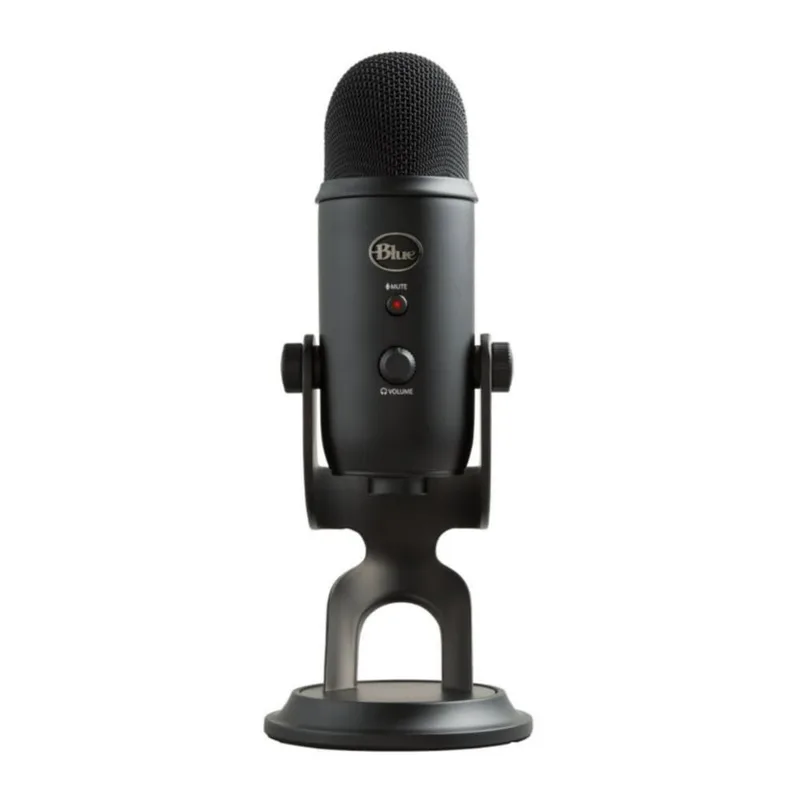
Blue Yeti X
Pros
- Four pickup patterns cover solo recording, interviews, group calls, and ambient capture
- 11-segment LED meter gives instant visual feedback on input levels from the desk
- 20Hz–20kHz frequency range captures full voice detail and instrument recordings
- USB plug-and-play — zero driver installation, recognized immediately by Zoom, Teams, and OBS
- Significantly cheaper than the MV7+ at comparable output quality in quiet rooms
Cons
- Condenser capsule picks up everything — keyboard clicks, fan noise, and room echo are all audible
- USB-A only — no USB-C connector, increasingly inconvenient on newer MacBooks and thin laptops
- Heavy at 2.68 lbs — not ideal for travel or portable setups
- Blue Voice effects software adds processing but can't fix a noisy recording environment
The Blue Yeti X remains the benchmark USB condenser for a reason. Four pickup patterns — cardioid, stereo, omnidirectional, and bidirectional — cover use cases that no dynamic mic can match. Stereo capture for instruments, omnidirectional for recording a room or a group around a table, bidirectional for in-person interviews: these modes justify the condenser choice in specific scenarios.
The 11-segment LED meter on the front of the mic displays input levels in real time without opening software. The Smart knob cycles through gain, headphone volume, and pickup pattern selection from a single control — a better hardware design than most competitors at this price point.
Where the Blue Yeti X struggles in 2026 home offices: the USB-A connector. Most current-generation MacBook Pros and Dell XPS machines have moved entirely to USB-C and Thunderbolt. An adapter works, but it’s an extra step and an extra thing to lose. The Shure MV7+, Rode NT-USB Mini, and most newer mics ship with USB-C as standard.
Owner reports on acoustic performance split along predictable lines. Users with carpeted rooms, soft furnishings, or acoustic panels rate the Blue Yeti X sound quality highly. Users in hard-surface apartments or open home offices report picking up more background noise than expected. If you’re considering this mic, honestly assess your recording environment first.
Who should buy this: Content creators, podcasters, and remote workers who record in acoustically treated or quiet spaces and want pickup pattern flexibility. Who should skip: Anyone with a noisy home office or open-plan layout — the condenser capsule will pick up everything the dynamic mics ignore.
Best Value Dynamic: Shure MV7
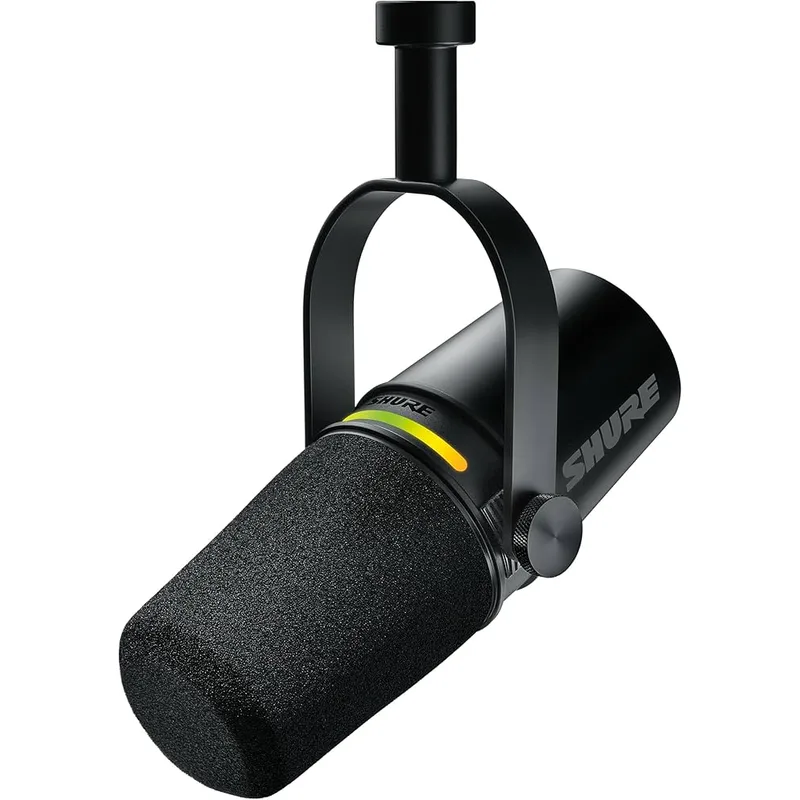
Shure MV7
Pros
- Dynamic noise rejection at a fraction of the MV7+ price — same core capsule design
- Dual USB-A and XLR output gives upgrade flexibility without buying a new mic
- All-metal housing survives desk life, bags, and shared environments without careful handling
- Touch mute panel on the body makes muting during calls tactile and reliable
Cons
- No Auto Level Mode — requires manual gain adjustment when environment or distance changes
- USB-A connector only; no USB-C unlike the newer MV7+
- No LED metering or visual feedback on input levels
- The MV7+ offers meaningfully better features at ~$150 more — gap has narrowed over time
The original Shure MV7 still makes sense for one buyer profile: someone who wants dynamic noise rejection without paying $269+ for the MV7+. At $136–$149, it matches the Blue Yeti X price bracket while delivering fundamentally better noise rejection for untreated home offices.
The MV7 lacks the Auto Level Mode, 32-bit float ADC, LED metering, and USB-C connector that the MV7+ adds. These are real omissions. Auto Level Mode in particular is more useful day-to-day than most buyers expect — it’s the feature that removes the constant gain-tweaking the original MV7 requires.
The all-metal housing is worth noting. The MV7 is built to a standard that most sub-$200 microphones don’t match. Owner feedback consistently mentions durability as a standout trait — this mic survives on desks, in bags, and in shared environments without protective handling.
If the ~$150 gap between MV7 and MV7+ strains your budget, the original MV7 is a legitimate choice. If the gap is manageable, the MV7+ is worth the premium for Auto Level Mode alone.
Who should buy this: Budget-conscious remote workers who want dynamic noise rejection and can live without Auto Level Mode. Who should skip: Anyone who does frequent call recordings with varying distance or volume — the lack of Auto Level Mode becomes frustrating quickly.
Best Budget/Portable: Rode NT-USB Mini
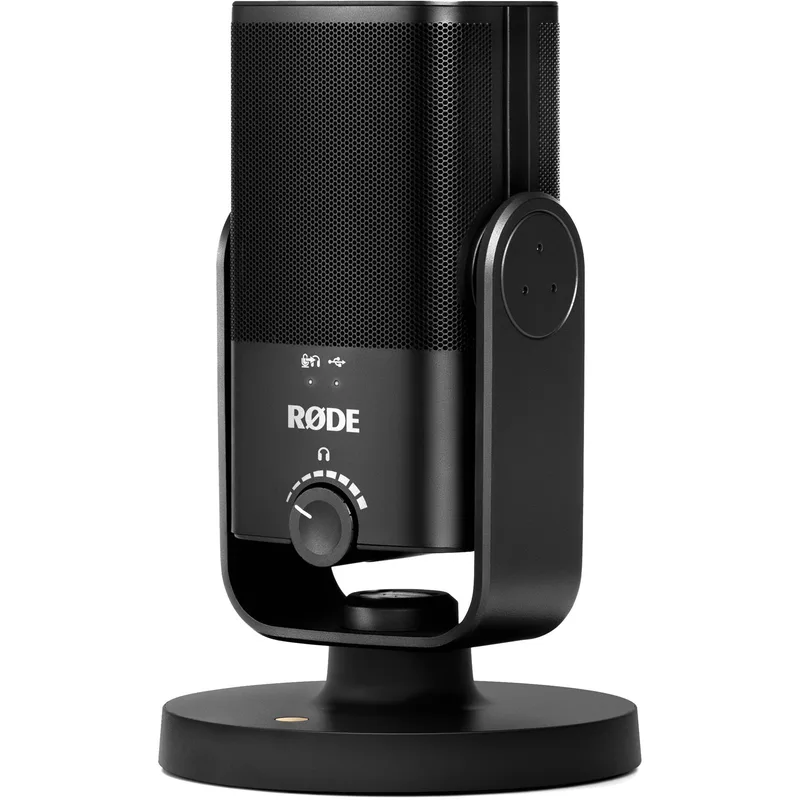
Rode NT-USB Mini
Pros
- Most compact option — integrated pop filter and stand means zero accessories needed out of the box
- USB-C connectivity is modern and compatible with current MacBooks and Windows laptops
- Warm, smooth condenser sound well-suited to voice recordings and calls
- Ultralight at 0.71 lbs — the only option here that makes sense for travel
Cons
- Condenser capsule picks up room noise like the Blue Yeti X — needs a quiet recording environment
- No XLR output — USB-only, no upgrade path to an audio interface
- Small integrated stand sits low — arm mounting requires a third-party cold shoe or stand adapter
- Less refined tone than the Blue Yeti X or Shure mics at a similar use-case
The Rode NT-USB Mini solves a specific problem: USB condenser sound quality with zero accessory requirements at under $100. The integrated pop filter and compact desktop stand mean you unbox it, plug the USB-C cable in, and you’re recording. No separate pop filter, no separate stand, no driver installation.
At 0.71 lbs with a compact footprint, the NT-USB Mini is the only mic in this comparison that makes practical sense to pack for travel. For remote workers who split time between a home office and a hotel or co-working space, the portability advantage is real.
The acoustic limitation matches the Blue Yeti X: as a condenser, it captures room noise. Owner feedback from apartment-based users frequently mentions picking up HVAC noise and street sound. The NT-USB Mini handles quiet environments well; noisy ones less so.
For calls and video meetings in a reasonably quiet space, the NT-USB Mini at $89–$99 delivers strong value. For recording quality content in a difficult acoustic environment, the Shure MV7 or MV7+ is a better investment.
Who should buy this: Remote workers who travel regularly and need a packable USB mic under $100. Who should skip: Anyone dealing with significant background noise — the condenser capsule will make that noise the star of your recordings.
Which Mic Should You Buy?
Buy the Shure MV7+ if your home office isn’t acoustically treated, you work from a room with hard surfaces or background noise, or you want the closest thing to automatic call audio management. The Auto Level Mode and dynamic noise rejection together solve the two biggest remote work audio problems. Default answer for most setups in 2026.
Buy the Blue Yeti X if you need multiple pickup patterns (interviews, instrument recording, group calls), your recording environment is quiet and treated, or you prefer a broader frequency capture for music production or voice acting alongside your remote work.
Buy the Shure MV7 if you want dynamic noise rejection on a tighter budget and can live without Auto Level Mode and LED metering. The all-metal build and dual USB/XLR output make it a strong long-term purchase.
Buy the Rode NT-USB Mini if you need a compact, portable setup under $100 and your recording environment is reasonably quiet. Ideal for light call use and travel.
Buying Guide: What Matters for Remote Work Microphones
Mic Type Comes First
Before brand or price, determine your environment. Open-plan space, hard floors, or background noise? Dynamic mic. Dedicated studio or acoustically-treated room? Either type works, and a condenser may sound more detailed.
USB-C vs USB-A
In 2026, USB-C is the current standard. If your laptop has only USB-C ports, a USB-A mic requires a hub or adapter. The Shure MV7+ and Rode NT-USB Mini ship with USB-C; the Blue Yeti X and Shure MV7 use USB-A.
XLR Output
XLR output matters if you might want to connect a mic to an audio interface later — for podcasting, voiceover, or higher-quality recording setups. The Shure MV7+ and MV7 have XLR. The Blue Yeti X and Rode NT-USB Mini are USB-only.
Monitoring
All four mics here include zero-latency headphone monitoring — plug headphones directly into the mic to hear yourself without the echo that software monitoring introduces. Standard at this price tier, but worth confirming on cheaper alternatives.
Boom Arm vs Desktop Stand
Dynamic mics perform best at 4–8 inches from your mouth; condensers are forgiving at 8–12 inches. Most home office users with a dynamic mic eventually add a boom arm to keep the mic at the correct distance without occupying desk space. Budget an additional $25–$60 for a decent boom arm if you’re buying a dynamic mic.
FAQ
Is the Blue Yeti X or Shure MV7+ better for Zoom and Teams calls?
For most home offices, the Shure MV7+ is better for calls. Its dynamic capsule rejects keyboard noise, HVAC hum, and ambient sound that Zoom’s background noise suppression then has less work to remove. The Blue Yeti X sounds richer in a quiet room, but real-world call quality in noisy environments typically favors the dynamic mic.
Do I need a boom arm with these microphones?
For dynamic mics (MV7, MV7+), a boom arm is strongly recommended. Dynamic mics need to be 4–8 inches from your mouth for optimal pickup, and a desktop stand puts the mic below your chin at the wrong angle. The Blue Yeti X and Rode NT-USB Mini are more forgiving of desk placement but still benefit from arm positioning.
Does the Shure MV7+ work with MacBooks and M-series chips?
Yes. The MV7+ connects via USB-C and is class-compliant — it appears as a standard audio device on macOS without driver installation. Compatible with M1, M2, M3, and M4 MacBooks.
What’s the actual difference between the Shure MV7 and MV7+?
The MV7+ adds: USB-C (vs USB-A), 32-bit float ADC (vs 24-bit), Auto Level Mode, an LED touch panel with real-time metering, and a digital pop filter processing mode. The MV7+ is meaningfully better for regular call use; the MV7 remains a solid choice if the ~$150 premium doesn’t fit the budget.
Can the Blue Yeti X be used for podcasting and calls?
Yes, but your recording environment matters significantly more than with a dynamic mic. For a dedicated podcast with a treated room, the Blue Yeti X sounds excellent and the four pickup patterns add flexibility. For mixed daily call use in a home office with ambient noise, the Shure MV7+ is likely a better fit.
Is the Shure MV7+ worth the price over the original MV7?
For regular remote work use, yes. Auto Level Mode alone justifies a significant portion of the premium — it removes the constant gain-tweaking that the original MV7 requires when your distance or environment changes. For occasional use, the MV7 is the better value.
Conclusion
The Shure MV7+ is the better pick for most remote workers in 2026. Dynamic noise rejection, Auto Level Mode, and USB-C connectivity address the real friction points of daily call use. In untreated home offices — which describes the majority of remote work setups — dynamic mics perform more reliably than condensers.
The Blue Yeti X earns its place for users who need pickup pattern flexibility, have a treated recording environment, or do content creation alongside their remote work. At $129–$149, it delivers better value-per-feature than the MV7+ for those specific use cases.
If budget is the primary constraint, the Shure MV7 at $136–$149 delivers the same noise rejection as the MV7+ at a lower price with fewer modern conveniences. The Rode NT-USB Mini rounds out the options for compact, travel-friendly use under $100.
Top pick: Shure MV7+ for most home office setups. Blue Yeti X for versatility in quiet rooms.
Detailed Reviews
Shure MV7+
Pros
- Dynamic capsule naturally rejects keyboard noise, HVAC hum, and off-axis sound — critical for untreated home offices
- Auto Level Mode keeps your voice at consistent volume without touching the gain dial
- 32-bit float recording prevents clipping even during loud moments like laughing or raised voice
- LED touch panel provides real-time metering and one-touch mute — visible from across the desk
- Dual USB-C and XLR output means you can use it now as USB and later with an audio interface
Cons
- Cardioid-only — no stereo or omnidirectional modes for recording music or multi-speaker meetings
- $299 street price sits above the Blue Yeti X; harder to justify for light-use calls only
- Dynamic mics require closer mic technique (4–8 inches) compared to condensers
Blue Yeti X
Pros
- Four pickup patterns cover solo recording, interviews, group calls, and ambient capture
- 11-segment LED meter gives instant visual feedback on input levels from the desk
- 20Hz–20kHz frequency range captures full voice detail and instrument recordings
- USB plug-and-play — zero driver installation, recognized immediately by Zoom, Teams, and OBS
- Significantly cheaper than the MV7+ at comparable output quality in quiet rooms
Cons
- Condenser capsule picks up everything — keyboard clicks, fan noise, and room echo are all audible
- USB-A only — no USB-C connector, increasingly inconvenient on newer MacBooks and thin laptops
- Heavy at 2.68 lbs — not ideal for travel or portable setups
- Blue Voice effects software adds processing but can't fix a noisy recording environment
Shure MV7
Pros
- Dynamic noise rejection at a fraction of the MV7+ price — same core capsule design
- Dual USB-A and XLR output gives upgrade flexibility without buying a new mic
- All-metal housing survives desk life, bags, and shared environments without careful handling
- Touch mute panel on the body makes muting during calls tactile and reliable
Cons
- No Auto Level Mode — requires manual gain adjustment when environment or distance changes
- USB-A connector only; no USB-C unlike the newer MV7+
- No LED metering or visual feedback on input levels
- The MV7+ offers meaningfully better features at ~$150 more — gap has narrowed over time
Rode NT-USB Mini
Pros
- Most compact option — integrated pop filter and stand means zero accessories needed out of the box
- USB-C connectivity is modern and compatible with current MacBooks and Windows laptops
- Warm, smooth condenser sound well-suited to voice recordings and calls
- Ultralight at 0.71 lbs — the only option here that makes sense for travel
Cons
- Condenser capsule picks up room noise like the Blue Yeti X — needs a quiet recording environment
- No XLR output — USB-only, no upgrade path to an audio interface
- Small integrated stand sits low — arm mounting requires a third-party cold shoe or stand adapter
- Less refined tone than the Blue Yeti X or Shure mics at a similar use-case