ExpressVPN’s March 2026 decision to discontinue its app for non-Aircove routers forced a lot of remote workers to reconsider their VPN setup. If you’ve been relying on a software VPN on each device individually, running it at the router level is the cleaner solution — one configuration protects every device on your network, including phones, smart TVs, and anything that can’t install a VPN app.
WireGuard has become the protocol of choice in 2026 for a clear reason: it runs significantly faster than OpenVPN at the router hardware level, with far lower CPU overhead. For remote workers who need full-tunnel VPN encryption without losing half their bandwidth, WireGuard on a capable router is the practical answer.
This guide covers five routers that actually deliver on VPN functionality — from a pocket travel option to an enterprise-grade small business setup. All prices reflect current Amazon availability.
Quick Comparison
| GL.iNet Beryl AX | GL.iNet Flint 2 | ASUS RT-AX86U Pro | Netgear XR1000 | Synology RT6600ax | |
|---|---|---|---|---|---|
| Price | ~$89 | ~$125 | ~$169 | ~$199 | ~$329 |
| WireGuard | Yes | Yes | Yes | No | No |
| OpenVPN | Yes | Yes | Yes | Yes (server) | Yes |
| VPN Throughput | ~350 Mbps | ~800 Mbps | ~550 Mbps | ~200 Mbps | ~300 Mbps |
| 2.5G WAN | Yes | Yes | Yes | No | Yes |
| Best For | Travel | Home office | Power users | Gaming + VPN | Small business |
Best Travel VPN Router: GL.iNet Beryl AX
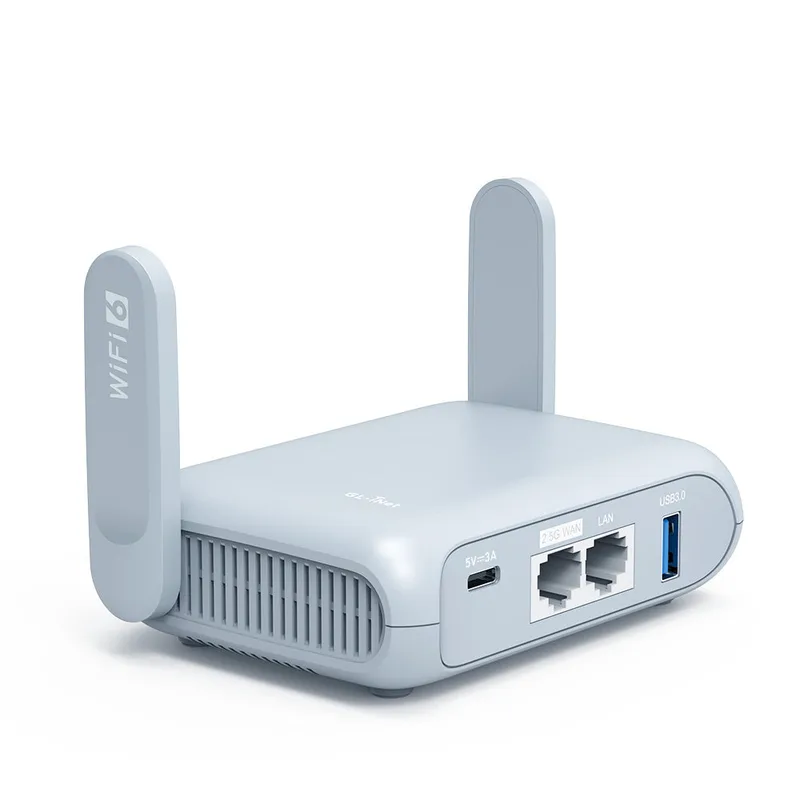
GL.iNet GL-MT3000 (Beryl AX)
Pros
- WireGuard and OpenVPN pre-installed — works with 30+ VPN providers out of the box
- Pocket-sized design fits in a travel bag; powers via USB-C from a laptop or power bank
- 2.5G WAN port handles fiber speeds even in a compact chassis
- VPN kill switch built-in — traffic drops rather than leaking if VPN connection fails
- Captive portal bypass handles hotel and coffee shop Wi-Fi authentication automatically
Cons
- Single LAN port limits wired device connections without an external switch
- Lower range than full-size routers — covers a hotel room or small home office, not a large home
- VPN throughput caps around 300-400 Mbps, which limits performance on gigabit+ connections
The Beryl AX is the most practical VPN router for remote workers who move between locations. It runs on OpenWrt with GL.iNet’s simplified UI on top, ships with WireGuard and OpenVPN pre-configured, and works with over 30 commercial VPN providers without manual configuration. You set up your VPN credentials once, and every device that connects to the Beryl AX — laptop, tablet, phone, smart TV — gets routed through the tunnel automatically.
The 2.5G WAN port is a surprisingly capable feature at this size and price. Plug into a fast hotel ethernet port or a gigabit home connection and the Beryl AX won’t bottleneck your bandwidth. WireGuard throughput lands around 300-400 Mbps on this hardware, which covers everything except the most bandwidth-intensive scenarios.
The built-in kill switch is the feature that matters most for professional use. If the VPN connection drops, the Beryl AX blocks all internet traffic rather than allowing it to fall back to an unencrypted connection. For workers handling confidential client data on hotel or shared Wi-Fi, this isn’t optional — it’s the whole point.
The single LAN port limits wired device connections, and range won’t cover a large apartment. But as a travel and secondary-location router that fits in a jacket pocket and powers off a laptop USB-C port, nothing else in this price range comes close.
Best Overall Home VPN Router: GL.iNet Flint 2
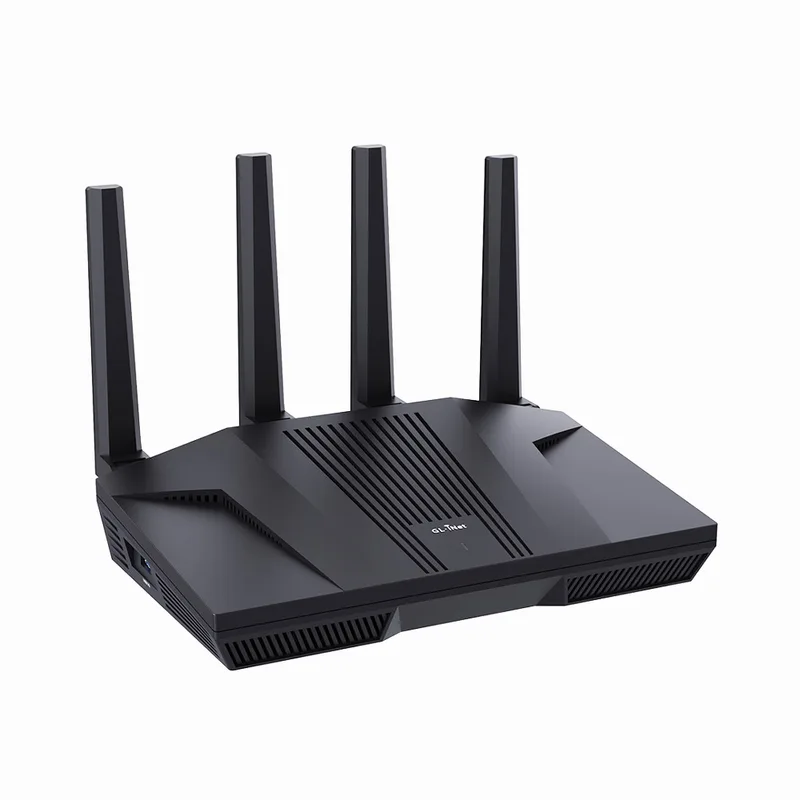
GL.iNet GL-MT6000 (Flint 2)
Pros
- Full OpenWrt base — install any package, customize any config, no locked-down proprietary firmware
- WireGuard server and client both built in — share VPN access with family devices or tunnel all traffic through a commercial provider
- Dual 2.5G ports handle multi-gig ISP plans without bottlenecking
- AdGuard Home integration blocks ads and trackers at the DNS level for every device on the network
- VPN throughput exceeds 800 Mbps on WireGuard — fast enough for 4K video conferencing over a VPN tunnel
Cons
- Requires some technical comfort to use advanced features beyond basic VPN setup
- GL.iNet firmware UI, while clean, is less polished than ASUS or Synology for enterprise-style management
- Dual-band only — no dedicated 6GHz band for WiFi 7 backhaul
The Flint 2 is the strongest all-around VPN router under $200. It runs full OpenWrt — meaning the entire open-source router ecosystem is available for customization — while maintaining GL.iNet’s clean consumer UI for users who don’t need to touch the command line. WireGuard and OpenVPN are both available as client or server, AdGuard Home is built in for network-level ad blocking, and the dual 2.5G ports handle ISP speeds up to about 2.5 Gbps without any bottleneck.
The VPN throughput is where the Flint 2 pulls ahead of most consumer routers. WireGuard performance is documented at over 800 Mbps on this hardware — fast enough to run a full VPN tunnel without compromising video conferencing quality or large file transfers. OpenVPN is significantly slower (around 100-150 Mbps), which is normal for AES-encrypted OpenVPN on consumer hardware.
The AdGuard integration protects every device on the network without requiring any app installs. DNS-level blocking means that trackers, ad networks, and known malicious domains get dropped before any device ever makes the request. For a home office where you’re mixing personal devices and work devices on the same network, this matters.
At around $125, the Flint 2 is the most capable VPN router per dollar. The only caveats: the GL.iNet UI is less polished than ASUS or Synology for enterprise-style management, and advanced features benefit from some familiarity with network concepts.
Best for Power Users: ASUS RT-AX86U Pro
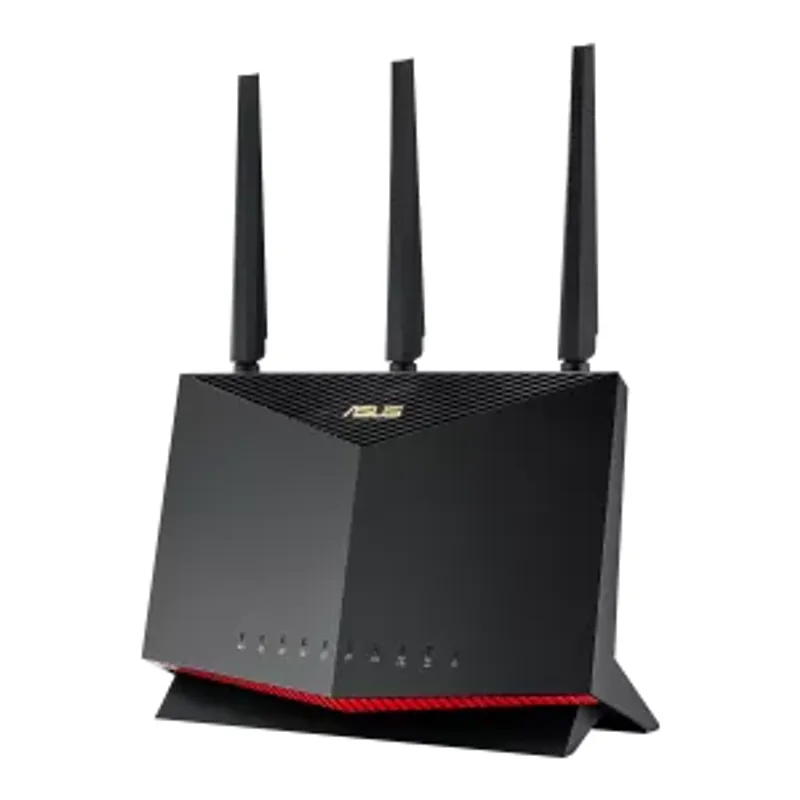
ASUS RT-AX86U Pro
Pros
- WireGuard and OpenVPN server built-in — run your own VPN server at home without a separate device
- VPN Director allows per-device routing rules — route one laptop through a VPN while leaving streaming devices on direct connection
- AiProtection Pro lifetime security (Trend Micro) included at no extra cost
- Merlin firmware compatibility adds additional VPN features, DNS-over-HTTPS, and detailed traffic logs
- 2.5G WAN and LAN port future-proofs for multi-gig ISP upgrades
Cons
- WiFi 6 only — no 6GHz band means it will not leverage newer WiFi 6E or 7 client devices at their peak
- VPN server performance is good but not exceptional — WireGuard saturates around 500-600 Mbps
- AsusWRT firmware has a learning curve for users new to advanced router settings
The RT-AX86U Pro does something few routers at this price offer: a full VPN server and client built into the firmware, with per-device routing rules that let you decide exactly which devices tunnel through a VPN and which connect directly.
That feature — called VPN Director in AsusWRT — is the practical differentiator. You can route your work laptop through a WireGuard tunnel to your office while leaving streaming devices on a direct connection. Corporate IT teams often require VPN access for work devices, and VPN Director lets you comply without slowing down everything else on the network.
AiProtection Pro is the other major advantage. Trend Micro’s commercial threat intelligence runs on the router itself, blocking malicious domains and flagging infected devices without any device-side software install. It’s included for the router’s lifetime at no extra cost — no subscription, no renewal.
Merlin firmware compatibility adds another layer for technical users. The community-developed Merlin firmware builds on AsusWRT and adds DNS-over-HTTPS, enhanced VPN logging, per-app kill switches, and additional customization that the stock firmware doesn’t expose. It runs on the RT-AX86U Pro without voiding support.
The WiFi 6 limitation is the honest note: this router won’t unlock 6GHz performance on newer client devices, and WireGuard throughput caps around 500-600 Mbps rather than the 800+ Mbps of the Flint 2. For a home office where you need polished firmware, corporate VPN compatibility, and lifetime security at a middle price point, the RT-AX86U Pro is the right call.
Best Gaming + VPN Combo: Netgear Nighthawk XR1000
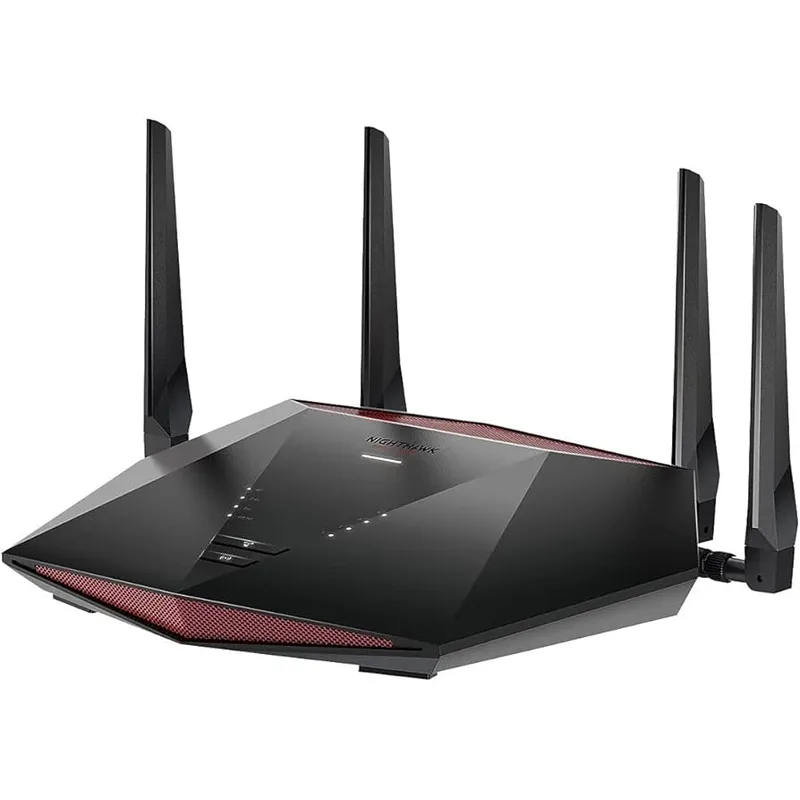
Netgear Nighthawk XR1000
Pros
- DumaOS 3.0 provides traffic prioritization by device and application — keep video calls stable even under heavy network load
- Built-in OpenVPN server for remote access to your home network
- Gaming VPN client mode routes traffic through a commercial VPN at the router level
- Netgear Armor security subscription includes Bitdefender threat protection
- Strong sustained WiFi 6 throughput for simultaneous heavy users
Cons
- No 2.5G WAN port — capped at 1 Gbps even with a multi-gig ISP plan
- Netgear Armor requires a paid annual subscription (~$100/year) for security features
- DumaOS VPN performance is lower than GL.iNet or ASUS — expect 150-250 Mbps over OpenVPN
- DumaOS is primarily optimized for gaming rather than enterprise remote work workflows
The XR1000 was designed for gaming first and picks up VPN functionality as a secondary feature through DumaOS 3.0. For remote workers who also game, that combination is useful: DumaOS’s traffic prioritization keeps video calls and VoIP stable even when other users are downloading large files, and the built-in OpenVPN server lets you maintain secure remote access to your home network while traveling.
DumaOS’s Geo-Filter and traffic shaping tools prioritize latency-sensitive applications over bulk transfers at the router level. On video calls, this translates to more consistent packet delivery and fewer dropped frames under load — a real benefit in households where multiple people share the connection for different purposes.
The Netgear Armor subscription (powered by Bitdefender) offers solid device-level threat scanning, though the recurring cost is a drawback compared to ASUS’s free lifetime AiProtection.
The significant limitations for VPN-focused buyers: no 2.5G WAN port caps the XR1000 at 1 Gbps, and OpenVPN throughput through DumaOS runs around 150-250 Mbps — noticeably slower than the GL.iNet or ASUS options. If VPN performance is the primary concern, the Flint 2 or RT-AX86U Pro are stronger choices. If you’re splitting use between work VPN and gaming performance, the XR1000 balances both reasonably well.
Best for Small Business: Synology RT6600ax
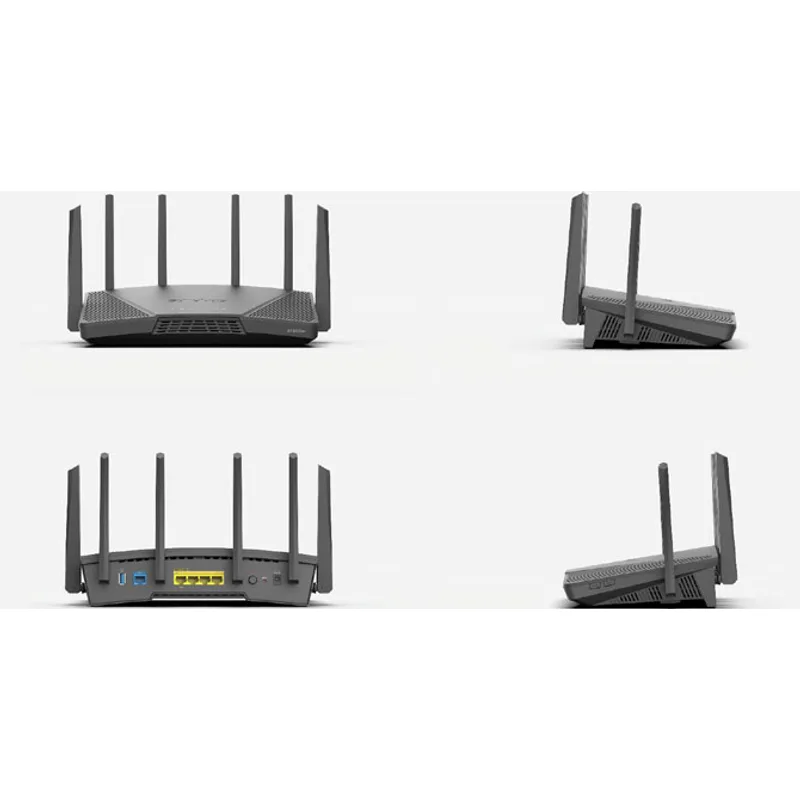
Synology RT6600ax
Pros
- VPN Plus package supports simultaneous VPN protocols — OpenVPN, L2TP/IPSec, SSTP, and site-to-site VPN in one router
- Inline threat prevention (IPS/IDS) scans actual packet payloads, not just DNS — the most comprehensive security of any consumer router
- Dual WAN ports with failover — pair a cable modem and 4G LTE backup for zero-downtime remote work
- VLAN and multiple SSID support for network segmentation — keep work devices isolated from personal IoT
- SRM firmware is among the most polished and enterprise-capable of any consumer router interface
Cons
- VPN Plus requires a separate license purchase beyond the base router cost
- Only three 1G LAN ports — no multi-gig wired switching for high-speed NAS or workstation connections
- No WiFi 7 — the RT6600ax is a WiFi 6 router at a premium price, making it hard to justify for future-proofing alone
- Setup takes longer than plug-and-play alternatives like GL.iNet
The RT6600ax is in a different category from the other routers here. Where GL.iNet and ASUS focus on consumer VPN functionality, Synology built the RT6600ax around the same enterprise networking concepts used in their NAS operating system — and the result is the most capable VPN server of any router at this price point.
VPN Plus (a separate license purchase) adds simultaneous support for OpenVPN, L2TP/IPSec, SSTP, and site-to-site VPN in a single router. Remote employees can access office resources via their preferred client, while the router handles protocol negotiation. For a small team of 5-15 people who need centralized VPN access without a dedicated server, this is the cost-effective path.
Threat Prevention goes further than any other consumer router’s security feature. Rather than DNS-level blocking, the RT6600ax performs inline IPS/IDS — inspecting actual packet payloads against a signature database for known attacks. It catches threats that DNS filtering misses entirely.
Dual WAN with failover is the feature home office users often overlook until they need it. Pair a cable modem on the 2.5G port and a 4G LTE USB modem on the USB 3.0 port, and the RT6600ax automatically routes traffic to the backup connection if the primary drops. For anyone billing hourly or running live client calls, connection continuity is worth the cost.
The price is high for a WiFi 6 router in 2026, and VPN Plus adds additional licensing cost on top. For individuals and small families, the Flint 2 or RT-AX86U Pro are better fits. For anyone running a legitimate small business from home with multiple employees or clients who need VPN access, the RT6600ax pays for itself in the functionality it replaces.
VPN Router Buying Guide
WireGuard vs OpenVPN
WireGuard is the right protocol in 2026. It’s faster, uses less CPU, and delivers better performance on the same hardware. GL.iNet routers handle WireGuard natively. ASUS AsusWRT has native WireGuard support on newer firmware versions. Synology’s VPN Plus still defaults to OpenVPN and L2TP for the widest compatibility.
OpenVPN remains necessary if your VPN provider or corporate IT only supports it. Most commercial VPN providers support both — check before buying hardware.
VPN Server vs VPN Client
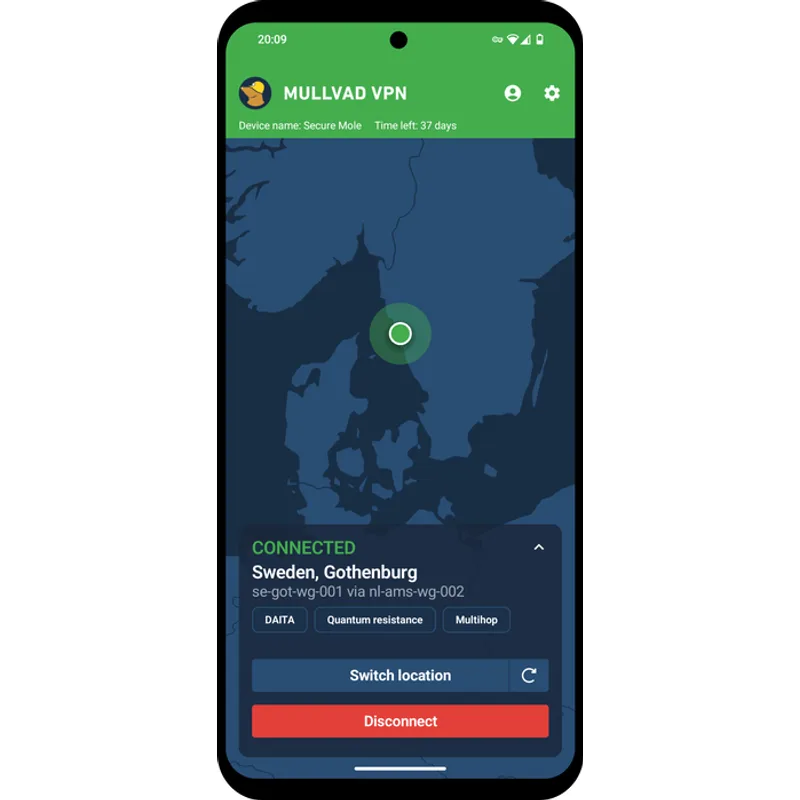
VPN client mode routes all your traffic through a commercial VPN provider (NordVPN, Mullvad, ProtonVPN, etc.). This is the setup most remote workers mean when they say “router VPN.”
VPN server mode turns your home router into a VPN server. When you’re traveling, you connect back to your home router and appear on the internet from your home IP. This is useful for accessing home network resources or bypassing geo-restrictions on services that work from home.
The ASUS RT-AX86U Pro and GL.iNet Flint 2 support both simultaneously.
Router VPN Performance
Consumer router VPN throughput depends on the processor, not the WiFi specification. WireGuard is significantly more efficient than OpenVPN — expect roughly:
- GL.iNet Flint 2: ~800 Mbps WireGuard
- ASUS RT-AX86U Pro: ~500-600 Mbps WireGuard
- GL.iNet Beryl AX: ~350 Mbps WireGuard
- Synology RT6600ax: ~300 Mbps OpenVPN
- Netgear XR1000: ~200 Mbps OpenVPN
If your ISP plan is 500 Mbps or less, any of these routers will handle full-speed VPN tunneling. At 1 Gbps or above, the Flint 2 is the only router here that can saturate your connection over WireGuard.
Picking the Right Router
For travel and co-working spaces: GL.iNet Beryl AX at $89. Pocket-sized, VPN kill switch, works with any provider.
For a home office on a budget: GL.iNet Flint 2 at $125. Best VPN throughput at the price, full OpenWrt, AdGuard built-in.
For corporate VPN and split tunneling: ASUS RT-AX86U Pro at $169. VPN Director for per-device rules, Merlin firmware compatibility, lifetime AiProtection.
For gaming + work balance: Netgear Nighthawk XR1000 at $199. Traffic prioritization for video calls, OpenVPN server for home access.
For a small business team: Synology RT6600ax at $329. Multi-protocol VPN server, IPS/IDS threat prevention, dual WAN failover.
FAQ
Do I need a VPN router or can I just run a VPN app? A VPN app on individual devices works fine for personal use. A router-level VPN makes sense when you have devices that can’t install VPN apps (smart TVs, IoT devices), when your employer requires VPN for all traffic including personal devices on your home network, or when you want one configuration to cover everything without managing software on each device.
Does running a VPN at the router level slow down my internet? Yes, but the impact depends on the protocol and router hardware. WireGuard on a capable router like the GL.iNet Flint 2 adds minimal overhead — throughput of 800 Mbps means most home internet plans won’t notice. OpenVPN is slower and more CPU-intensive. The slowest options here (XR1000 and Synology on OpenVPN) cap around 200-300 Mbps, which is still above average US home broadband speeds.
Which VPN providers work with these routers? GL.iNet routers officially support NordVPN, Surfshark, ExpressVPN, Mullvad, ProtonVPN, and 30+ others through built-in configuration templates. ASUS and Netgear routers work with any provider that supports OpenVPN config file import. Synology’s VPN Plus works with its own client protocols and any provider that supports OpenVPN.
Is a separate VPN subscription required? Yes. These routers handle the VPN tunnel, but you still need a VPN provider subscription (typically $3-8/month for a reputable service). Alternatively, ASUS and GL.iNet both support running your own WireGuard server on the router itself, which eliminates the need for a commercial VPN service if you just want to access your home network remotely.
Can I run a VPN server and connect to a VPN provider at the same time? On GL.iNet Flint 2 and ASUS RT-AX86U Pro, yes. The Flint 2 supports running a WireGuard server while simultaneously tunneling specific clients through a commercial VPN provider. ASUS VPN Director handles this through its per-device routing rules.
Verdict
For most remote workers, the GL.iNet Flint 2 at $125 is the strongest overall choice. WireGuard throughput that handles any home internet plan, full OpenWrt flexibility, AdGuard Home for network-wide ad blocking, and dual 2.5G ports — all for well under the price of the ASUS or Synology options.
If you need polished firmware with per-device VPN routing rules and corporate VPN compatibility, the ASUS RT-AX86U Pro at $169 adds meaningful capabilities for a $44 premium.
For travel, nothing beats the GL.iNet Beryl AX at $89 — it fits in a bag and protects every device on hotel or shared Wi-Fi with minimal setup.
For teams and small businesses needing multi-protocol VPN server access, the Synology RT6600ax is the only consumer router that actually fits the requirement.
Detailed Reviews
GL.iNet GL-MT3000 (Beryl AX)
Pros
- WireGuard and OpenVPN pre-installed — works with 30+ VPN providers out of the box
- Pocket-sized design fits in a travel bag; powers via USB-C from a laptop or power bank
- 2.5G WAN port handles fiber speeds even in a compact chassis
- VPN kill switch built-in — traffic drops rather than leaking if VPN connection fails
- Captive portal bypass handles hotel and coffee shop Wi-Fi authentication automatically
Cons
- Single LAN port limits wired device connections without an external switch
- Lower range than full-size routers — covers a hotel room or small home office, not a large home
- VPN throughput caps around 300-400 Mbps, which limits performance on gigabit+ connections
GL.iNet GL-MT6000 (Flint 2)
Pros
- Full OpenWrt base — install any package, customize any config, no locked-down proprietary firmware
- WireGuard server and client both built in — share VPN access with family devices or tunnel all traffic through a commercial provider
- Dual 2.5G ports handle multi-gig ISP plans without bottlenecking
- AdGuard Home integration blocks ads and trackers at the DNS level for every device on the network
- VPN throughput exceeds 800 Mbps on WireGuard — fast enough for 4K video conferencing over a VPN tunnel
Cons
- Requires some technical comfort to use advanced features beyond basic VPN setup
- GL.iNet firmware UI, while clean, is less polished than ASUS or Synology for enterprise-style management
- Dual-band only — no dedicated 6GHz band for WiFi 7 backhaul
ASUS RT-AX86U Pro
Pros
- WireGuard and OpenVPN server built-in — run your own VPN server at home without a separate device
- VPN Director allows per-device routing rules — route one laptop through a VPN while leaving streaming devices on direct connection
- AiProtection Pro lifetime security (Trend Micro) included at no extra cost
- Merlin firmware compatibility adds additional VPN features, DNS-over-HTTPS, and detailed traffic logs
- 2.5G WAN and LAN port future-proofs for multi-gig ISP upgrades
Cons
- WiFi 6 only — no 6GHz band means it will not leverage newer WiFi 6E or 7 client devices at their peak
- VPN server performance is good but not exceptional — WireGuard saturates around 500-600 Mbps
- AsusWRT firmware has a learning curve for users new to advanced router settings
Netgear Nighthawk XR1000
Pros
- DumaOS 3.0 provides traffic prioritization by device and application — keep video calls stable even under heavy network load
- Built-in OpenVPN server for remote access to your home network
- Gaming VPN client mode routes traffic through a commercial VPN at the router level
- Netgear Armor security subscription includes Bitdefender threat protection
- Strong sustained WiFi 6 throughput for simultaneous heavy users
Cons
- No 2.5G WAN port — capped at 1 Gbps even with a multi-gig ISP plan
- Netgear Armor requires a paid annual subscription (~$100/year) for security features
- DumaOS VPN performance is lower than GL.iNet or ASUS — expect 150-250 Mbps over OpenVPN
- DumaOS is primarily optimized for gaming rather than enterprise remote work workflows
Synology RT6600ax
Pros
- VPN Plus package supports simultaneous VPN protocols — OpenVPN, L2TP/IPSec, SSTP, and site-to-site VPN in one router
- Inline threat prevention (IPS/IDS) scans actual packet payloads, not just DNS — the most comprehensive security of any consumer router
- Dual WAN ports with failover — pair a cable modem and 4G LTE backup for zero-downtime remote work
- VLAN and multiple SSID support for network segmentation — keep work devices isolated from personal IoT
- SRM firmware is among the most polished and enterprise-capable of any consumer router interface
Cons
- VPN Plus requires a separate license purchase beyond the base router cost
- Only three 1G LAN ports — no multi-gig wired switching for high-speed NAS or workstation connections
- No WiFi 7 — the RT6600ax is a WiFi 6 router at a premium price, making it hard to justify for future-proofing alone
- Setup takes longer than plug-and-play alternatives like GL.iNet